
Introduction to Education and Philosophy
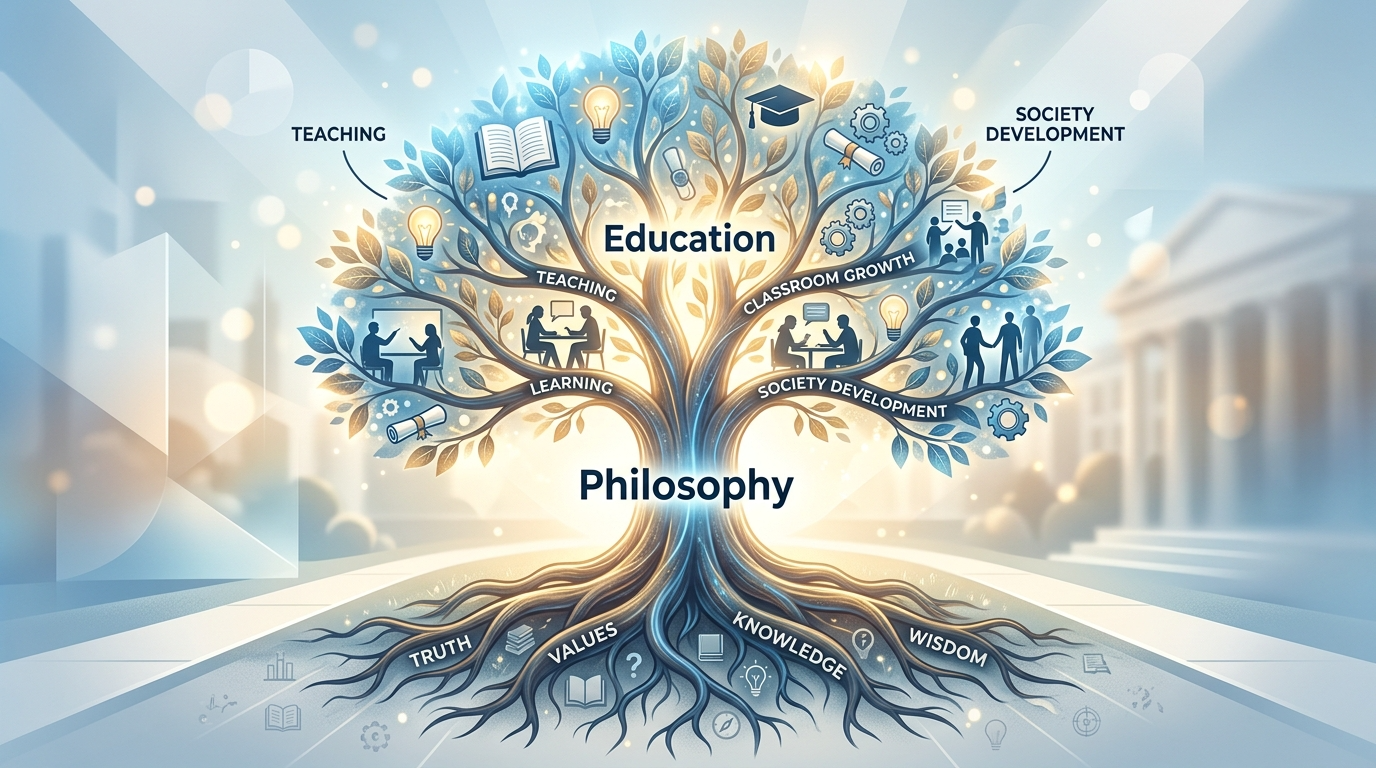
The relationship between philosophy and education is very deep and interdependent.The relationship between philosophy and education is very deep and interdependent. Philosophy provides the ideas, aims, values, and direction of life, while education works as the practical process that applies those ideas. Philosophy determines what teachers should teach, why they should teach it, and what goals education should achieve. On the other hand, education helps people apply philosophical thoughts in real-life situations. On the other hand, education helps in applying philosophical thoughts in real life situations.
Both philosophy and education share a close connection because philosophy provides the theoretical foundation, whereas education gives practical shape to those theories.Philosophy deals with truth, reality, knowledge, and values, while education develops the individual according to those principles. Therefore, philosophy guides education, and education spreads and applies philosophy in society.
Many great philosophers such as Plato, Socrates, Gandhi, Tagore, and Aurobindo were also great educationists. Their philosophical ideas strongly influenced educational aims, methods, and systems. Hence, philosophy and education always remain connected, as both work together for the development of human life and society
Meaning and Origin of Philosophy
Philosophy — there are many chances that this question may come, that from which word it has come. The word philosophy has come from two Greek words, “Phila + Sophia,” meaning “love of wisdom,” or sometimes it is also called knowledge. Now, meaning you have some love towards wisdom, you want to know things, and you are wandering here and there in search of truth. That will be the literal meaning of philosophy. Remember this thing that it has come from a Greek word.

So if we talk about the literal meaning, then what is philosophy showing? It is showing that this philosopher is constantly engaged wherever he goes in the search for truth, meaning in the search for wisdom. Whoever is a philosopher, that person loves wisdom and is trying to find some new thing here.
Now when we talk about the meaning of philosophy, many Indian and Western philosophers have given different definitions. From all these definitions, if we draw a conclusion, then we get two emphasized points.
- Philosophy has a critical aspect.
- Philosophy has a synthetic aspect.
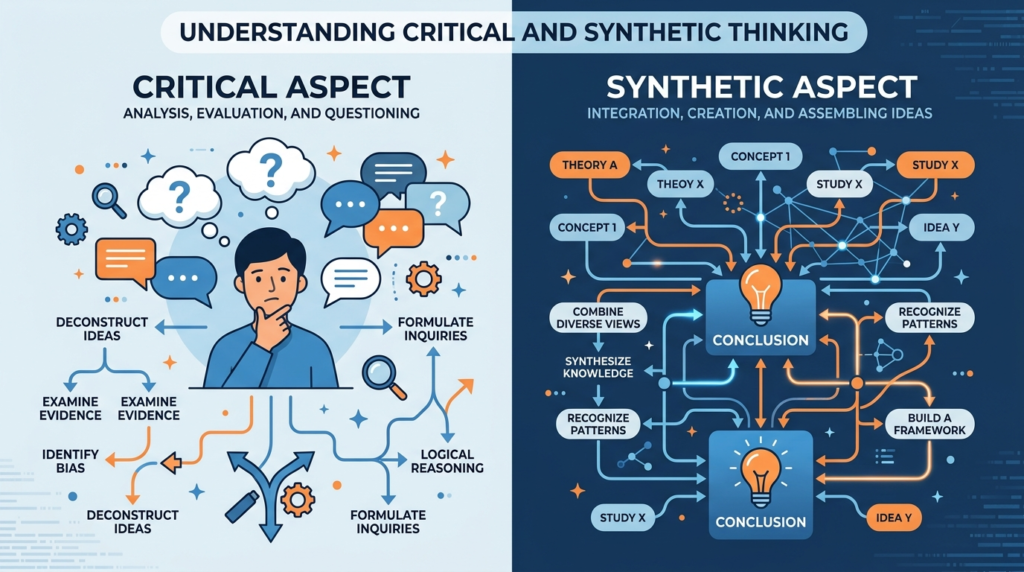
So we should have some idea about these two aspects, that philosophy is basically trying to say that philosophy is a critical method when you approach experience.
Suppose you do any thing, so in this you will not get a conclusion. What will we focus on? We will focus on the approach, on what experience you had. Many times it happens that you are sitting in your friend group and you say something, and you want your friend to either support your side or not support it, but your friend is a little smart, who is neither supporting your side nor supporting the other point, he is somewhere trying to balance things midway, that this thing may also be right, this approach may also be right, this person’s point is also right.
Such situations happen many times. Then we say that there is no need to show so much philosophy. So the same thing is here, that whoever is “showing philosophy,” that person is approaching it critically, about how that thing happened, instead of directly jumping to the conclusion.
So this is a critical method of approaching any experience that you have experienced, of analyzing it. Okay.
Definitions and Aspects of Philosophy
Let us see a related definition. There is Brightman’s definition:
“Philosophy is essentially a spirit and method of approaching experience.”
So you are approaching experience rather than reaching a conclusion because of the experience you had. Okay, so you are not drawing a conclusion, you are critically thinking about it.
“It is not the specific content of the conclusion.”
He has also said this thing, that you are not jumping upon the conclusion, but this is the method through which philosophy is trying to describe its philosophical aspect.
So this was the critical aspect.
The second is the comprehensively synthetic science or synthetic aspect of philosophy. Meaning, just like in science there are many theories, then we reach conclusions, similarly in philosophy also, like science, there are many theories which lead us toward systematic reflection, that this thing is happening, that thing is happening, therefore we are saying that this point A is correct.
Okay, so you will get a systematic reflection here. Therefore, we can say that philosophy is handling things like a synthetic science. Meaning this is not experimental science, we are not doing things practically here, but by arranging our thoughts systematically, we are reaching one point that yes, because of these things we can say this as well.
Okay, so you should know these two aspects of philosophy.
Branches of Philosophy
Now “Branches of Philosophy.” This is also a completely philosophical topic, obviously because we are talking about philosophy, so you should definitely know these terms, the branches of philosophy.
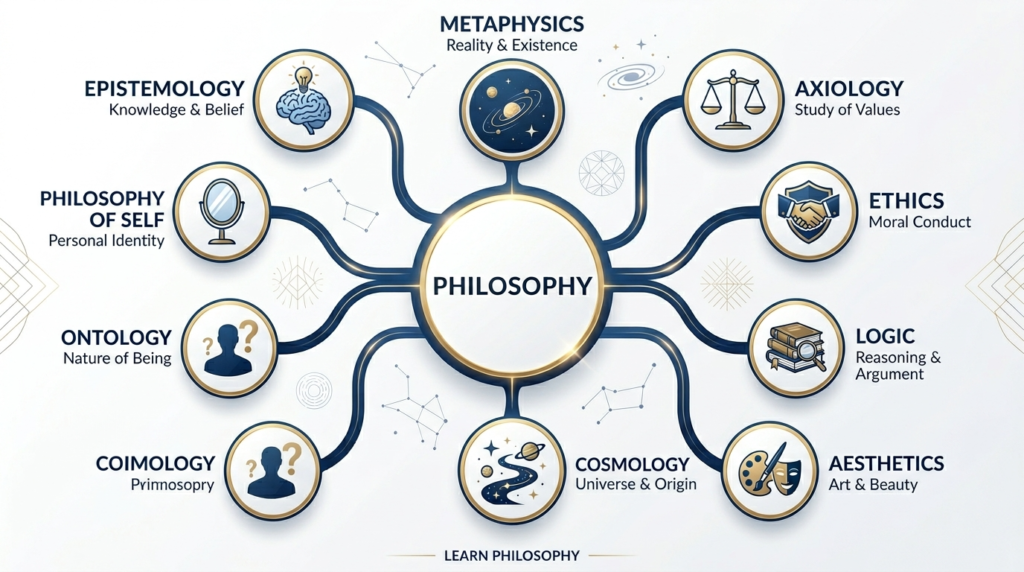
Many times it is asked:
- What we study in epistemology?
- What we study in metaphysics?
- What axiology means?
So chances of such small questions increase from this topic.
Epistemology
Epistemology — you should know that this talks about the process of knowing. Meaning, you are in search of knowledge, how will you get knowledge, what will the process be.
So when we talk about that search which you are doing, then that is the branch of epistemology.
This branch, the search we are talking about, is a very critical search because the first problem that comes out here is:
- What will be the nature of knowledge?
- What will be its limitations?
- What kind of knowledge will it be?
Therefore, epistemology is also called the most fundamental branch of philosophy because it deals with philosophical truth, the validity of knowledge, the limits of knowledge, what the nature of knowledge will be, who is obtaining knowledge, and from where.
So it talks about all these things, meaning the process of knowing.
Metaphysics
What happens in metaphysics? We talk about existence, we talk about reality.
Okay, so this is the study of existence, reality, and essence.
Its further branches are:
- Cosmogony
- Cosmology
- Ontology
- Philosophy of Self
- Eschatology
Cosmogony
Cosmogony means the study of creation.
Questions like:
- Who made this world?
- How was it made?
- Who created it?
- Why was it created?
- For what purpose was it created?
All such problems and questions related to creation come under cosmogony.
Cosmology
In cosmology, the main problem is whether the world is one or many.
Ontology
Ontology talks about ultimate reality, about what truth is and what reality is.
Philosophy of Self
Philosophy of self talks about:
- What is the self?
- What relationship does it have with the body?
- Is there only one self or many selves?
Eschatology
Eschatology means the condition of the soul.
Meaning, after death what will happen to our soul, what will be the nature of the universe — all these after-death related things are discussed in eschatology.
Axiology and Other Branches
Axiology studies values, and in values come:
- Ethics
- Beauty
- Logic
Ethics
In ethics, what comes is the situation of good, right, and wrong — whether something is ethically right or wrong.
Aesthetics
In aesthetics, the nature and criterion of beauty are discussed.
Logic
In logic, definitely the subject matter includes what the method of judgment will be, what type of propositions and conclusions are there.
Education and Its Meaning
Then comes education. So education has come from a Latin word, whereas our philosophy came from a Greek word, so remember this difference.

The word “Educatum” means to train.
- “E” means from inside.
- “Duc” or “duco” means to draw out or to lead out or to bring out.
So the overall conclusion is that you are trying to bring out something, or to lead out, or to bring out.
Now when we talk about the meaning of education, what is the narrow meaning of education and what is the broader meaning.
Narrow Meaning of Education
In the narrow sense, education means only those instructions that are given in school.
Meaning:
- Whatever the teacher teaches
- Whatever things elders in society have already said
- Whatever structured things and methods of teaching are already being used
That itself is education.
The teacher is expected to give the ready-made dose of knowledge to the child, that whatever information the teacher gave, the child memorized it in the mind, and that is education in the narrow sense.
Broad Meaning of Education
As soon as we move out of school instruction and talk about overall development, where education is not limited only to school, then the broader sense comes, where all the experiences that you have had from birth till death become education.
Life also teaches things in a way, right? So that is also education.
Whatever you are learning informally becomes a lifelong process of growth and development.
Education as a Dynamic Process
There is also an analytical meaning of education, in which we study the analytical part, that education is not limited only to school.
We are trying to develop the child’s innate powers in a better way, whatever qualities are within him.
Education is a dynamic process, not a static process, because static means fixed.
Nothing is fixed in education.
- Situations change
- Time changes
- Experiences change
Meaning our education also changes.
So education is dynamic.
Bipolar Process of Education
Education is a bipolar process. Adams said this in his book “Evolution of Educational Theory.”
Bipolar means:
- One pole is the teacher
- The other pole is the pupil
The teacher will teach, the child will learn.
Tripolar Process of Education
John Dewey called it a tripolar process.
The three poles are:
- Teacher
- Child
- Social environment
So this sociological aspect, the aspect of society, he also included this in education.
Education and Relationship Between Philosophy and Education
Now let us talk about the relationship.
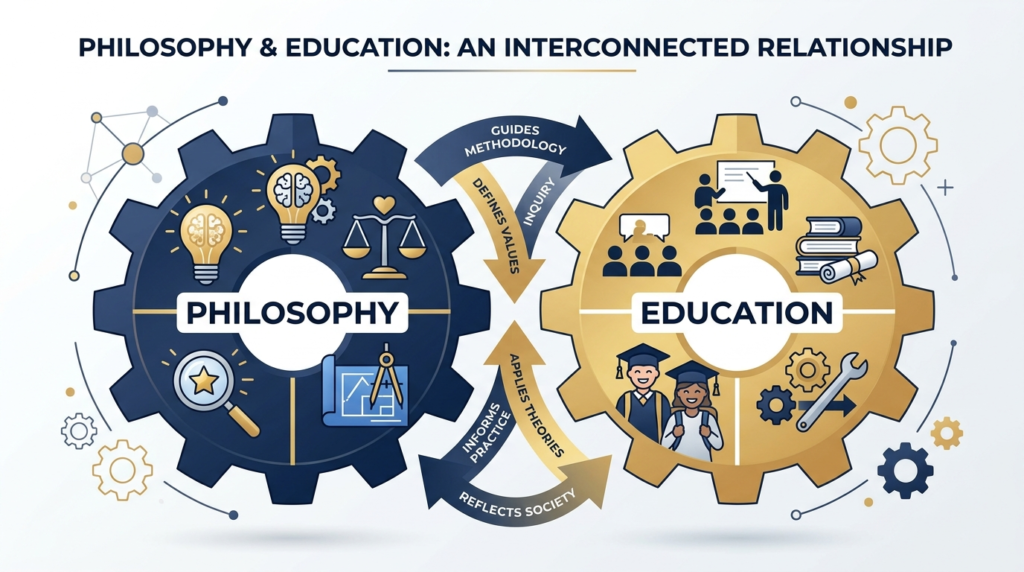
In the relationship, education is dependent on philosophy and philosophy is also dependent on education.
So you should remember that this interdependence itself is the relationship, that both depend upon each other.
How Education is Dependent on Philosophy
Philosophy determines the real destination, meaning what ultimately has to be done in education.
Philosophy determines the goals of life and also provides suitable and effective guidance for education so that we can achieve those goals.
Spencer also said:
“True education is practicable only by a true philosophy.”
Meaning education is dependent on philosophy.
Philosophy Determines Many Aspects of Education
Many scholars believed that philosophy talks only about abstract things, whereas education talks about practical and concrete things.
But this belief is absolutely wrong.
Both philosophy and education are intimately and integrally connected.
That is why we call them interdependent.
Great Philosophers and Education
Many great philosophers turned out to be very great educationists.
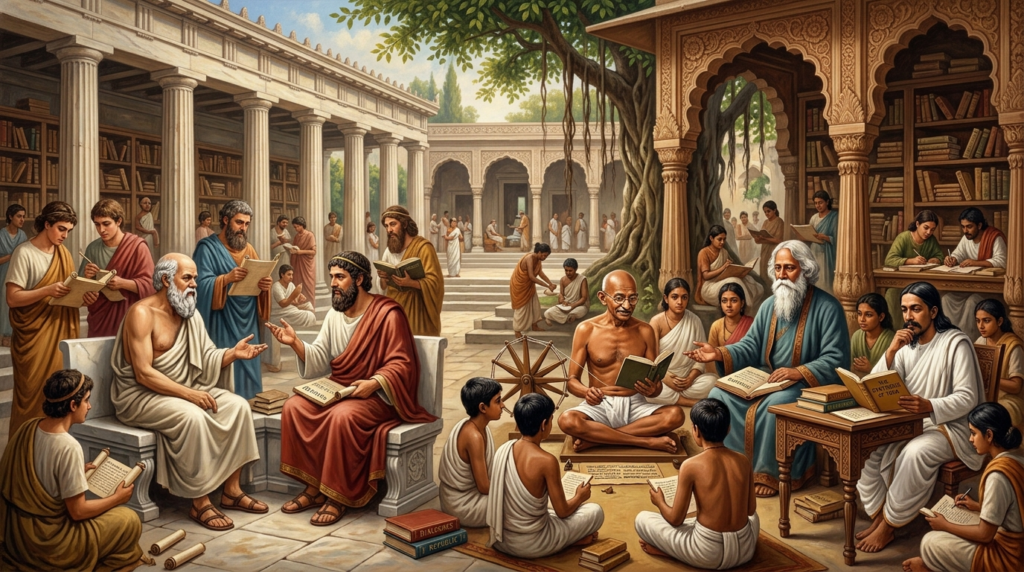
Examples include:
- Plato
- Socrates
- Locke
- Comenius
- Gandhi
- Tagore
- Aurobindo
All these people were excellent philosophers, and they talked about education, so they became great educationists.
How Philosophy is Dependent on Education
Now let us discuss the last point — how philosophy is dependent on education.
Education is the dynamic side of philosophy.
Meaning, in any task you do:
- First there is thought and planning
- Then comes execution and application
So the application part is education, and philosophy is thought.
If philosophy talks about thought and planning, then education talks about implementing it.
Adams also said that education is the dynamic side of philosophy.
So education in one way becomes a path, a means, for achieving those goals which philosophy had thought of and determined.
Conclusion
So from this we understood what the relationship is.
Overall:
- First we studied education
- Then philosophy
- Then the relationship between both
- Then how education is dependent on philosophy
- Then how philosophy is dependent on education
So both depend on each other and they have an interdependent relationship.