

In today’s article, we’re going to discuss the topic “Subject Knowledge in Curriculum,” meaning of knowledge.
What is knowledge? In simple words, having information about anything, having proper information about it, that is knowledge. We also gain knowledge in our daily life, and in daily life, there are many such things—you experience something or the other, and you learn something or the other; some knowledge you get daily. Knowledge starts coming to us from the first day of life, and till the end, we keep getting knowledge. Now, whether that knowledge is in formal or informal form, we will also see. But what is knowledge? Information about facts, information about skills, information about objects—that is, knowledge, properly, having information about it.
Knowledge Through Facts
For example, let’s take facts—see, knowing any fact, like:
- I know that it is night now, so after night there will be day
- If it is day, then after day there will be night
- Similarly, winter will come, summer will come, rainy season will also come in between
So these are some points about which I have proper knowledge.
For example, let’s take another example—if I get a fever or I am not feeling well, so there is some illness, I know that my body temperature has increased, so I know what knowledge I have for it, that I have to take cough syrup for it.
So see, you can apply anything—about everything it is necessary to have knowledge, plus we also learn daily, life, and this process even starts from then.
Knowledge Through Skills
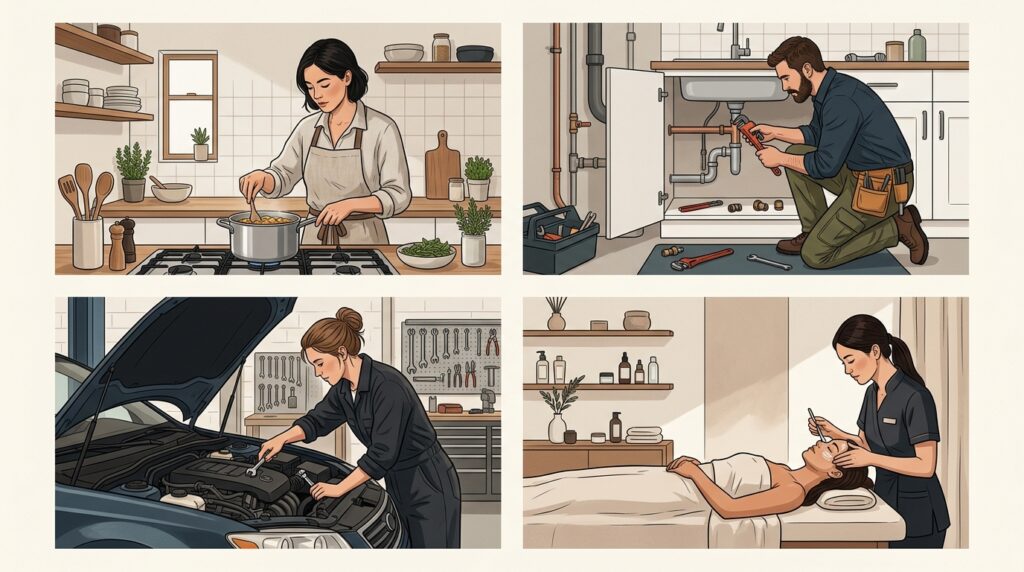
If we talk about skills, see any profession—take any example:
- If your mother cooks food in the kitchen, then she has proper knowledge of how food is made; she has knowledge about that.
- Similarly, if someone does not know how to cook and goes into the kitchen, then he will not be able to cook because he does not have the knowledge about that skill.
- Similarly, if there is a plumber, then he has proper knowledge about plumbing work
- If there is a mechanic, then he knows about that
- Similarly, if there is a beautician, a dealer, a cobbler—any profession—he has proper information about his particular skill
That is why he has knowledge, and that is why he is working.
Knowledge About Objects
Next, knowledge about objects—for example, if I have to buy a car, then it is very important that I know about it. If not, then I will collect that knowledge from here and there.
For example:
- My house is in the hills, there are rough roads, and I have to buy a good car
- So I will talk to people living there, my neighbors, or those who already have a car
- I will ask which car will be best for such areas
So it is very important, whatever object you are buying.
For example:
- Even if you are buying utensils, you will see what size utensil I need for a particular need
Similarly:
- If I have to buy a bike and I have to travel far, travel 30–40 kilometers daily
- Then I will gain proper knowledge about which bike will be good for me
- Which average will be good
- Which bike will suit me

So that:
- My cost is less
- It is perfect for me
- It has good maintenance
So, all these things’ knowledge I will take from others, I will search on the internet, from anywhere I can take knowledge, but taking that knowledge before buying any object will be important for me.
Sources of Knowledge
Read this—knowledge can be acquired in many different ways and from different sources.
See, knowledge is not derived from only one place; there are different sources of it and not limited sources:
- Experience
- Education
- Reason
- Memory
- Scientific inquiry
- Exploration
- Practice
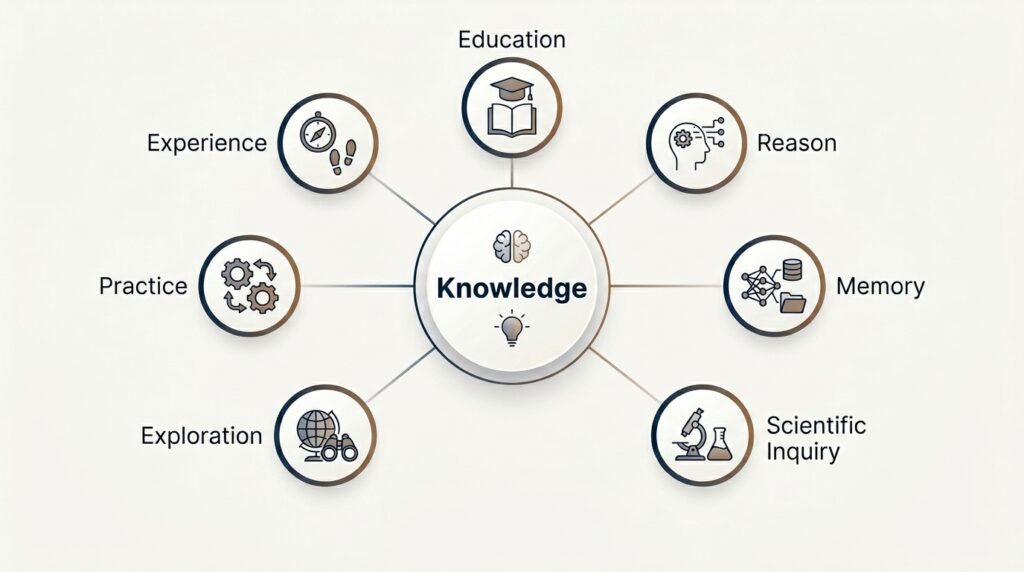
From all these things, a person learns something daily; every day we experience something, from which we learn something.
Practice makes man perfect—this is a saying—so the more we practice, the more we learn, and our knowledge keeps increasing.
Practical Understanding of Knowledge
Knowledge is the proper study—knowledge can be difficult, and a practical understanding of a subject is necessary.
It is not necessary that I pick up a subject and now I have knowledge; practical knowledge is very important.
See, like music:
- Music is a subject purely based on practice
- Now, in it, you study many things about musicians
- But along with that, you must have the information and knowledge of how to apply it
- How to play the harmonium, different instruments
Practical knowledge is very important.
Then such subjects are based on knowledge—everything is practical knowledge.
For example:
- In music, you need proper knowledge of notes, from which note to which note you have to sing
- In cooking, also—how to cook anything
- For example, if I have to make dal, then how to make it
For that proper practical knowledge, real knowledge is very necessary for me.
Learning Beyond School
A child does not learn everything only in school.
- If he is traveling in his school bus, many things happen to him
- He learns a lot from his friends
- He experiences a lot
- Plus at his home, in his neighborhood—means outside also, beyond school boundaries, he learns a lot
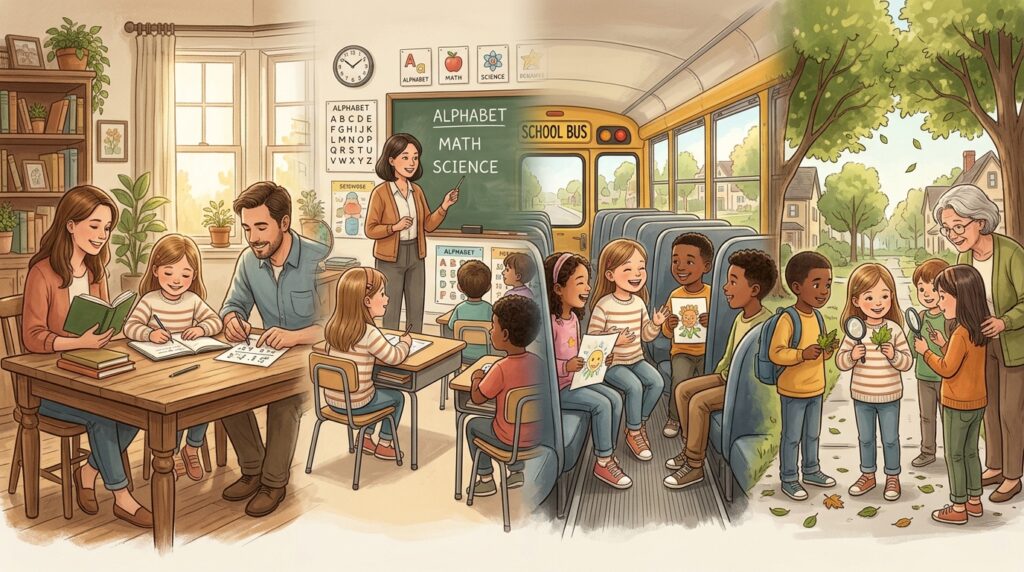
So in this way:
- Both practical and theoretical knowledge are important
- In both ways, a person acquires knowledge
Plus:
- In formal, we also achieve knowledge
- In informal, we also get it
As I told you in the example.
Knowledge and Reality
Knowledge reflects truth about reality—it makes us face the truth.
Knowledge is very important; in day-to-day life, a person keeps acquiring it, and we also do it.
- When we meet the world
- When we connect with the world
Our knowledge keeps increasing.
If we talk from a child’s perspective:
- First, the child learns very small things—eating food, toilet habits, and wearing clothes
- After that, the child grows
- He takes a lot of knowledge from his neighborhood
- Before that, from the family
- Then neighborhood
- Then school, teachers
He explores the world. His knowledge keeps enhancing
Knowledge Through Engagement
Knowledge is the result of one’s active engagement with the objects of knowledge.
See, like an engineer:
- When he goes to the field
- Before going to the field, it will be important for him to have proper knowledge
- He will not start working on the first day
Before working:
- How the work is done—he should have that information
- Knowledge is necessary
How does he collect it?
- Practically, he sees others
- First, he has theoretical knowledge
- He reads it out
- After taking proper knowledge
- After seeing practically
- Then he starts working
Even in that:
- He learns a lot from his experience
- His knowledge keeps increasing day by day
Relationship Between Knower and Known
Knowledge and its intensity depend upon the relationship between the knower and the known.
- Whenever we get knowledge of anything
- A relationship is built there between the knower and the known
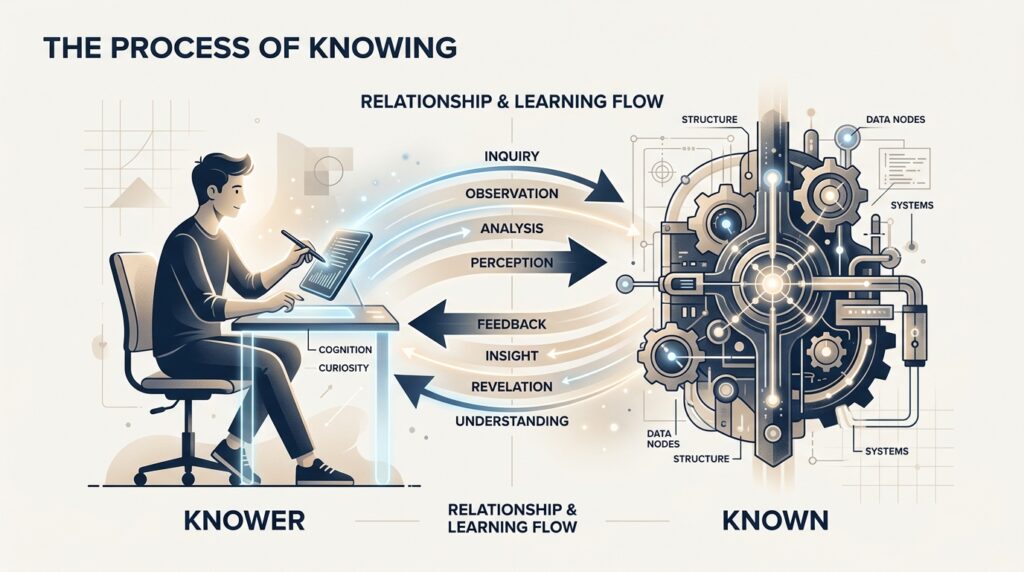
For example:
- When an engineering student sees practically how work is done
- Then a bond is formed with that work
How?
- He comes to know how that work is done
- Day by day, his knowledge increases
The knower and known—what is the concept?
- The work is known to him
- The knower is the person who has information about that work
So a relationship is formed between both.
Knowledge Through Interaction with the World
Next, knowledge develops through individuals’ interaction with the world.
As I told you:
- First, the child learns how to eat, bathe, body habits, and toilet
- Then he takes knowledge from his family
- A lot from parents
- Then family
- Then neighborhood
- Then school, teachers
In this way:
- As the interaction of an individual increases
- His knowledge also increases
That is why:
- An individual must interact with the world
If we talk about you today:
- You have knowledge today because you have interacted
- You did your graduation
- You went to different colleges
- Then you are doing B.Ed.
- Here you have different knowledge
Similarly:
- In school life, you get different kinds of knowledge
- If you do a job, new knowledge also comes
The more:
- You mix up with the world
- You are interactive with the world
Your knowledge will increase. You have also experienced it, and you can relate to it. It is important—everyone should interact with the world—so that knowledge can be developed on a daily basis.
Stay Connected with us!
Not long ago I became interested in numismatics.
I was looking for coin market insights, but many resources were too general.
I found useful information on https://groshi.xyz
The site provides interesting articles about collectible currencies.
I found the information quite useful.