
When it comes to educational thinkers, a few names consistently dominate exam syllabi and discussions—Rabindranath Tagore, Swami Vivekananda, Aurobindo Ghosh, and Mahatma Gandhi. Among them, Rabindranath Tagore holds a unique place, not only as a literary genius but also as a visionary educational philosopher. In this article, we will explore his ideas, contributions, and key concepts in a structured way, along with important points and previous year questions that exams frequently include.
Rabindranath Tagore & Major Educational Thinkers
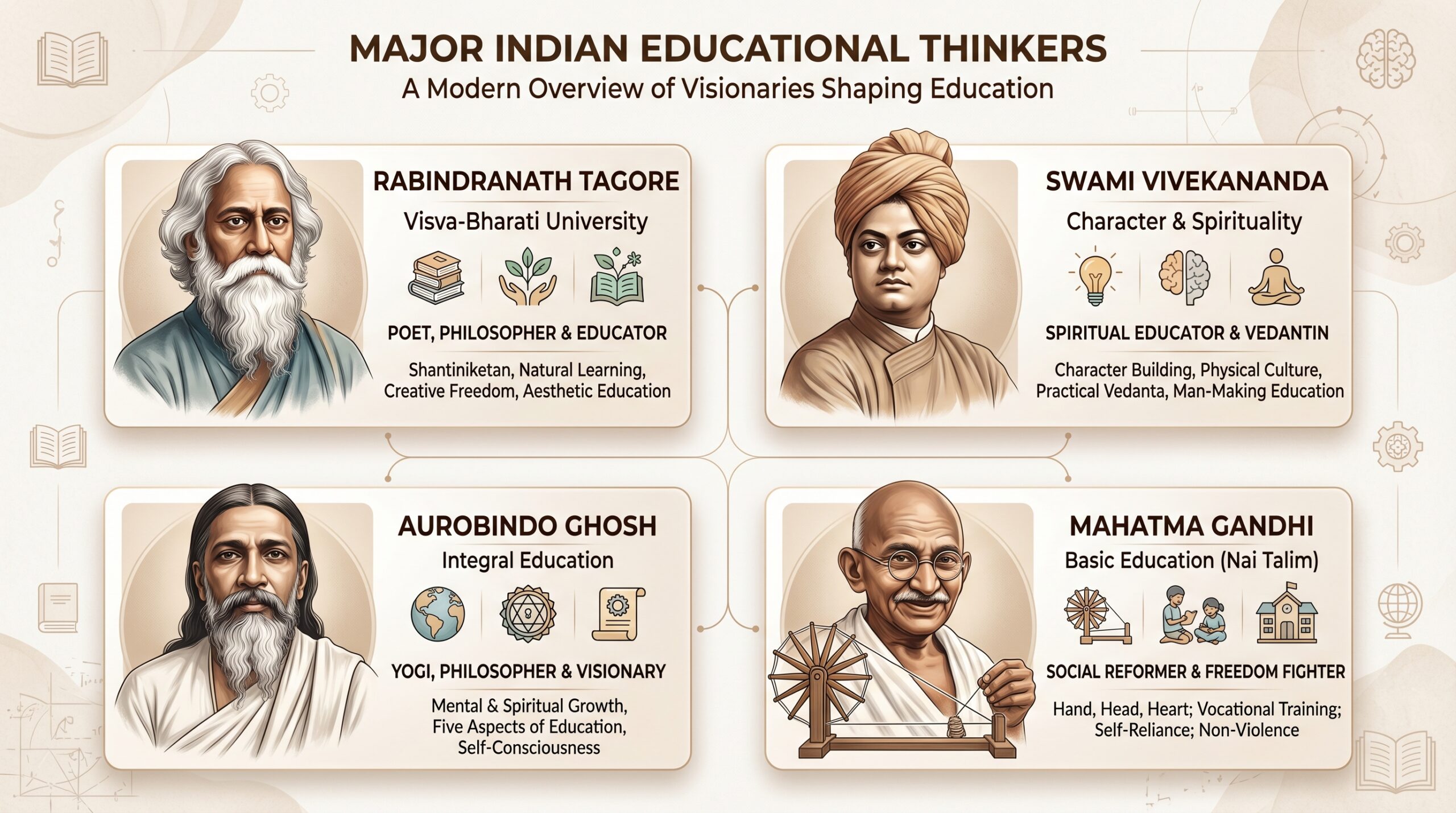
Rabindranath Tagore Educational Thinkers Overview
If we talk about Rabindranath Tagore, then usually what do we know about him—that he wrote the national anthem of India.
Second thing you have to remember is internationalism, because just like Gandhi ji believed in nationalism, similarly Rabindranath Tagore believed in internationalism. So you should remember that internationalism meant that the whole world is one, and we should not be separate from anyone, and we should try to learn something from each other.

Internationalism gained recognition at that time through their efforts. They received the Nobel Prize in Literature, and this is important information to remember. They received it for Gitanjali, which they wrote in English.
The point is along with this he was a music composer, composed more than 200 songs very well, under the name pencil visit he did, because at that time he had visited 34 countries. Then he was a social reformer.
Now there are many works, among them you should remember mostly those from which questions come:
- Chaturanga
- Char Adhyay
- Nouka Dubi
- Home and the World
- Universal
Detailed Background of Rabindranath Tagore
So this is roughly about Rabindranath Tagore. If we talk a little in detail, then his birth family name was Khush, but his family at that time used British pronunciation, under that later people started calling him Tagore, so the surname Tagore became famous.
Raja Ram Mohan Roy, his Brahmo Samaj culture, his family were members of that. And in 1864 his brother Satyendranath Tagore became the first Indian who subscribed the Indian Administrative Service.
If we know a little about his childhood, it was quite difficult because both parents stayed busy with work, so servants raised him, and his brother taught him. Gradually, people took him to Shantiniketan due to his performance. After that, he also studied in London, including law and oil; this is also a part, but the college where he studied still teaches a series in his name even today.
Important Associations
Rabindranath Tagore gave Subhas Chandra Bose the title “Desh Nayak,” meaning country’s hero.
In 1939 his views on Gandhi ji also conflicted at many places, but along with conflict they were also very good friends of each other. So these are the main points related to Rabindranath Tagore that you should know.
Philosophy of Rabindranath Tagore
If we talk about his philosophy, then his approach was like an individualist and naturalist.
According to his philosophy, what kind of values a philosopher should have, he says:
- Like an individualist there should be freedom, meaning the individual should have freedom to work in his own way, and along with this to think at his own level.
- Like a realist, ultimate truth, to know ultimate truth, to attain moksha, one should subscribe at a spiritual level.
- Like internationalism, no one is completely independent; we must work with unity. Even God depends on man—if we create the universe, it depends on us, so God also depends on it.
The teacher can be a natural experiencer, his concept was like that. And this quality should also be there, so all these qualities should be there.
Key Principles
If we talk about Rabindranath Tagore, then we talked about:
- Naturalism
- Humanism
- Internationalism
Other principles include:
- Harmony in all things, meaning you have to take everything together.
- Principle of freedom—we talked that a person should have the right to live life in his own way and take decisions.
- Principle of creativity of expression—how you present yourself in front of others.
- Active communion with nature and man.
- Education should be natural in content, quality over all academic education.
Educational Philosophy
If we talk about educational philosophy, then he believed that the child should do things according to himself, not that you force him that you should not do this or that, rather connect the child with the real world, teach things in real world with experience.
If we talk about his inspiration, then the environment of home was like that, love of nature, he traveled to many countries, from one place to another, so you see a lot, meet many new people, so his thinking was very broad.
He established Shantiniketan, you should remember that today it is popularly known as a university town, Shantiniketan, which is about 150 kilometers north of Kolkata in West Bengal, and there is also Visva-Bharati University there, you should remember that.
Rabindranath Tagore made Shantiniketan a model where everything is learned through experience.
Aims of Education
If we talk about aims of education, then:
- Moral and spiritual development
- At every level a person should try to improve
- Physical and intellectual development
- International brotherhood
That the world should move towards unity and brotherhood, this should be in everyone. Education should be full, you should remember this.
Discipline and Curriculum
If we talk about discipline, then from his ideas we know that tuition should be like an open house, in which students and teachers work together like an open loop, in this way they move forward together in life.
Educational institutions must not be like dead institutions, where students are only spoon-fed, meaning ready-made information is given, such institutions he did not consider as real education institutions.
He said do not drink and do not debit, boys were encouraged to manage their own friends, meaning students should be encouraged to solve their own problems.
So what will happen is that the child’s development will be complete. Curriculum should be such that it includes experiential learning. Laboratory was also available at that time in Shantiniketan, so he emphasized learning by doing, learning through experience.
Role of Teacher
Now what will be the role of teacher—he described teacher as a friend and philosopher.
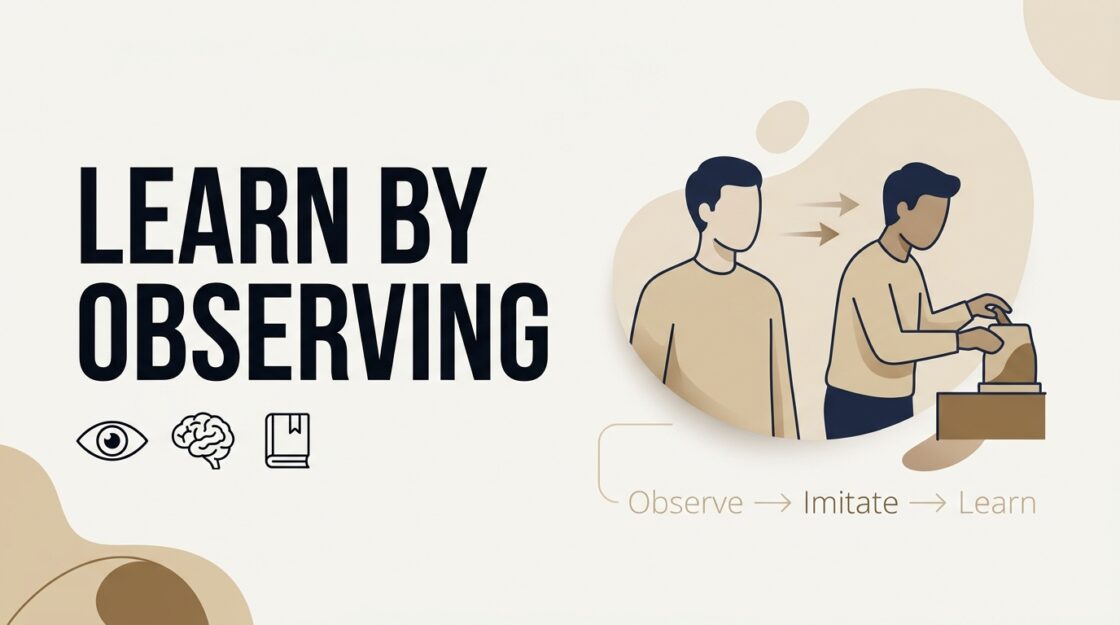
Basically children learn more quickly by observing the teacher’s personality than by the knowledge imparted by him. That means small children learn more from the personality and habits of the teacher than from what he says.
So the personality of the teacher should be very good, this was his belief. So if such a statement comes, then who said it—Rabindranath Tagore.
A teacher can never truly teach unless he is still learning himself.
Teaching Methods
Rabindranath Tagore emphasized an important lesson for children—improvisation, meaning it is not necessary that what you learn today will remain the same for life, changes keep happening, learning is a continuous process, so we should always keep scope for improvement.
Children should be given opportunities to explore their capacities, whether success or failure, after everything there should be an explanation, and they should keep bringing out their potential.
Method of teaching:
- Teacher should not play the role of a dictator, but of a friend and philosopher.
- Teaching should be activity-based, dynamic, independent study should be there so that you learn by doing things yourself.
- Third, the methods that were used earlier were mechanical, stereotyped, dull and uninteresting.
- Education should be interesting, based on freedom and creativity.
- Best method is when you are talking with the child while walking and showing things, that is the best method of teaching.
- Learning by doing concept was given, from known to unknown, based on previous knowledge introduce new things.
Matching and Works
Match the following:
- Gandhi ji talked about basic education
- Tagore talked about naturalistic and international education
- Aurobindo talked about integral education
- Vivekananda talked about man-making education
Works:
- Gandhi wrote “My Experiments with Truth”
- Tagore wrote “Universal Man”
- Aurobindo wrote “Savitri”
- Vivekananda wrote “Practical Vedanta”
“Where the mind is without fear” poem was written by Tagore.
Education in environment-friendly and natural surroundings is related to Tagore. Students should be free to do what they want in such environment.
Conclusion
Rabindranath Tagore received Nobel Prize not for education institution, but for literature, for the English version of Gitanjali. He was the first Asian to receive Nobel Prize.