

Introduction to Cognitive Development
Jerome Bruner’s Cognitive Development Theory explains how children learn and represent knowledge as they grow. According to this theory, learning is an active process. Therefore, children construct new ideas based on their current and past knowledge.
Understanding
The first thing to remember is Bruner’s three stages of cognitive development. There are many situations. Each theory is different. Piaget’s is different. Someone has given cognitive development. Someone has given social development. There are observational ones. So there are many.
Among them, you have to remember that in cognitive development, he is American. He has made a very good contribution to human cognitive psychology. So, you have to remember the word cognitive with his name.
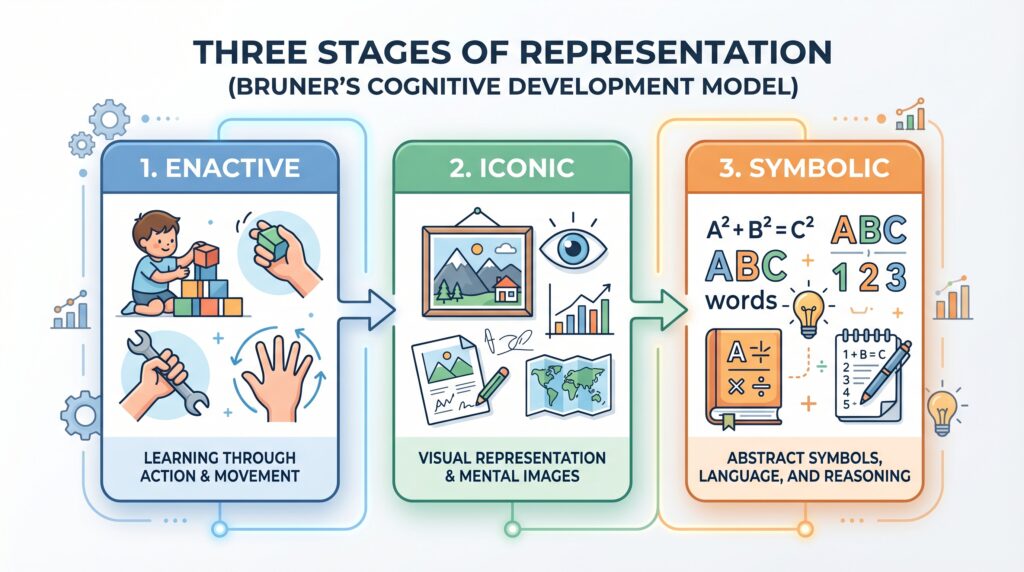
The theory mainly focuses on three stages (modes) of representation:
Enactive Stage – Children gain knowledge through actions. They learn by doing, touching, and manipulating objects. At an early stage, children start crawling to pick up their favourite toys.
Iconic Stage – Children represent knowledge through images and visuals. They start understanding things by seeing pictures or mental images. In this stage, children should figure out what certain things look like.
Symbolic Stage – Children represent knowledge through symbols like language, numbers, and abstract thinking. In this stage, children are aware of mathematics and symbols. Children are aware with the mathematic and symbols.
Bruner emphasized that these stages are not strictly age-bound and can overlap. His theory highlights “learning by doing” and the importance of active participation in the learning process.
Stages of Cognitive Development:
Now he has three stages, you can call them stages of cognitive development, or you can call them modes of learning, that there are three series, how the child will see things.
Now he has three stages, you can call them stages of cognitive development, or you can call them modes of learning, that there are three series, how the child will see things.
1. Enactive Stage
So the first is enactive. Remember that it is enactive, not inactive. A small child, from birth to two or three years, you have to say like that.

In this stage, the child, in a way, if you give any child a chance to do something, he will try to touch it. Then, he will try to grab it. Also, he will try to take it in his mouth. Therefore, it will be related to movement reaction.
In the enactive stage, children gained knowledge through actions, i.e., learning by doing, touching, and manipulating objects.
2. Iconic Stage
In the ionic stage, children gained knowledge through images and visuals. Children begin to understand things by seeing pictures or mental images.

The second thing will be the iconic stage. It is considered from three to eight years of age. If there is a little up and down in the age, then keep that in mind. First is enactive, then iconic.
So what will be there in iconic? An icon means seeing pictures and icons of images. The child can learn by seeing them. Like here we visualize. Here we have a book. From that book, he is seeing.
3. Symbolic Stage
Symbolically, what will be there, that now things will be understood through symbols, which is considered above eight years of age. If we compare with Piaget, he talked about concrete, which is after eleven years. So if you compare that and remember, it will be better for you.

The third thing is symbolic for children over 8 years old. In this, the child himself can research and see things. He can experience things properly and from other things also. So abstract symbols and imagination come here. You can call it learning mode. It can also be called the three stages. It can also be referred to as three changes of representation. You have to remember all three names.
Bruner’s Theory of Cognitive Development
So basically, in Bruner’s theory, you have to remember that:
He has given three units of development
He is an American psychologist
He has contributed a lot to cognitive psychology
There are three changes: enactive, iconic, and symbolic
Bruner emphasized that these stages are flexible and not strictly fixed by age. His theory highlights the importance of active learning, discovery, and understanding, making it highly relevant in education and exam preparation.
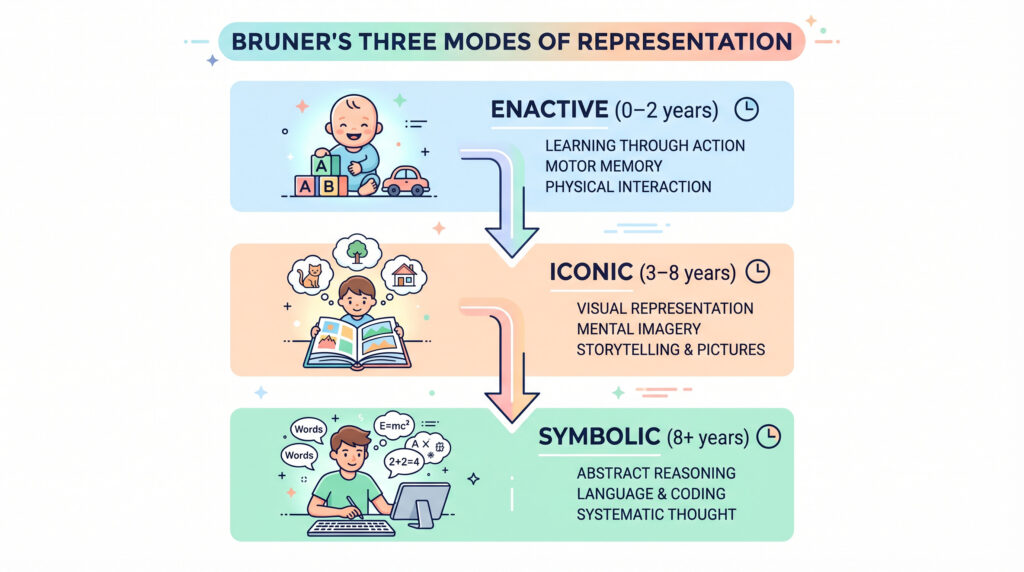
If we see a little, then enactive represents knowledge through actions, by doing, learning by doing, the major principle here will be that the child stores things in memory by doing physical actions, so physical actions matter more here.
In the iconic stage, there will be a visual representation of images, of icons, as you have seen, learning in this will be stored like images, that is, by using visual senses, we use this, we visualize things.
And last will be the symbolic stage, in which abstract things come; it explains experiences, which will be stored in your mind in the form of symbols, so this is the symbolic stage.
Conclusion
Bruner’s Cognitive Development Theory highlights how children learn through enactive, iconic, and symbolic stages. These stages explain how knowledge develops from actions to images and then to abstract symbols.



Normally I don’t read article on blogs, but I wish to say that this write-up very forced me to try and do it! Your writing style has been surprised me. Thanks, quite nice article.
You can reply:
Thank you so much for your kind words! I’m really glad you enjoyed the article. It means a lot to know that it encouraged you to read through it. I hope you’ll enjoy future articles too!☺️
I must express my affection for your generosity supporting all those that must have help with this important situation. Your personal commitment to passing the solution all around turned out to be exceedingly advantageous and have empowered guys and women just like me to attain their targets. Your personal helpful tips and hints denotes so much a person like me and substantially more to my peers. Best wishes; from each one of us.