
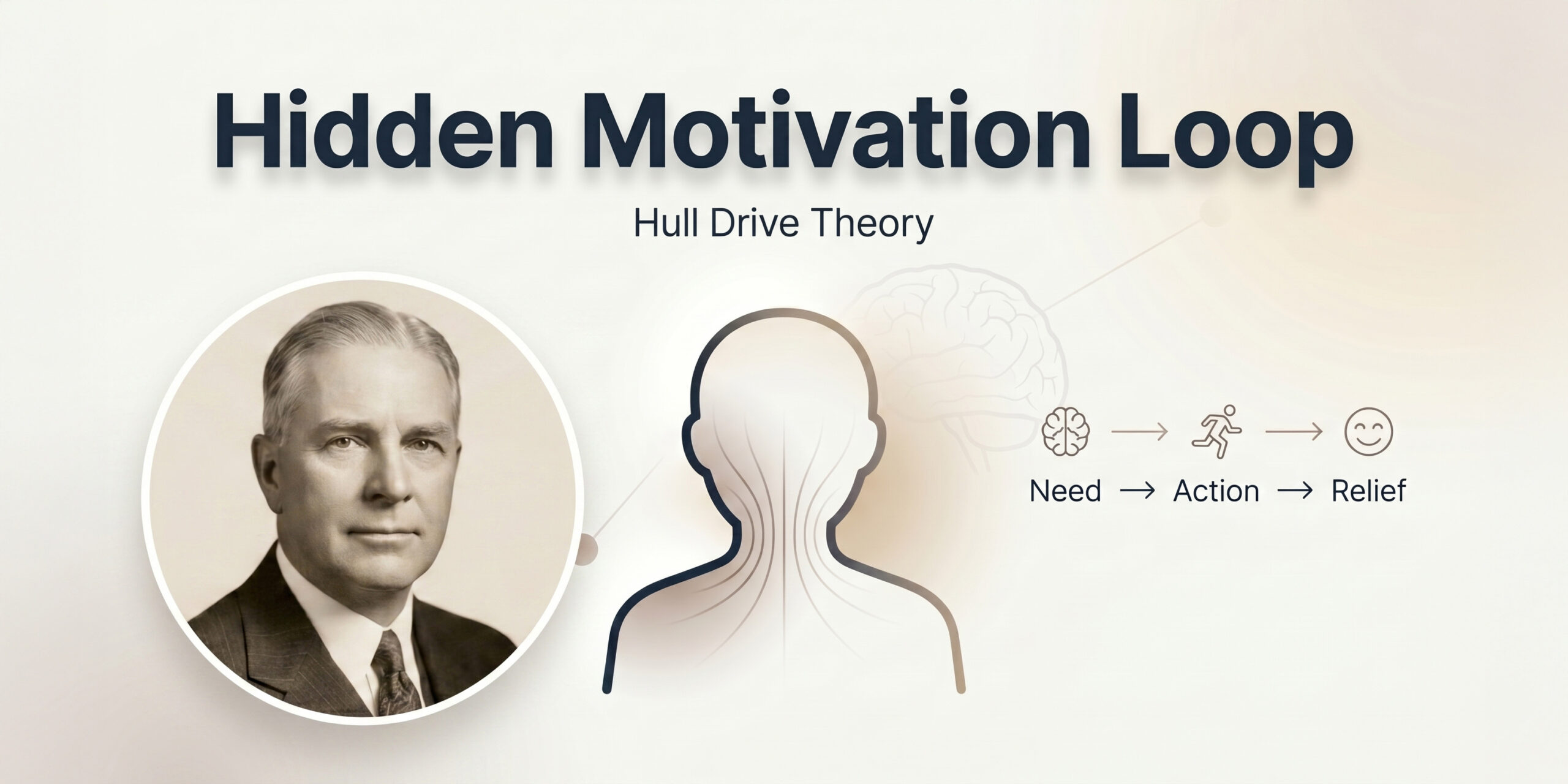
Today, we will talk about Hull’s Reinforcement Theory and Drive Reduction Model. If we talk about Hull’s Reinforcement Theory, then it is related to learning. But if we talk about his Drive Reduction Model, then it is related to motivation.
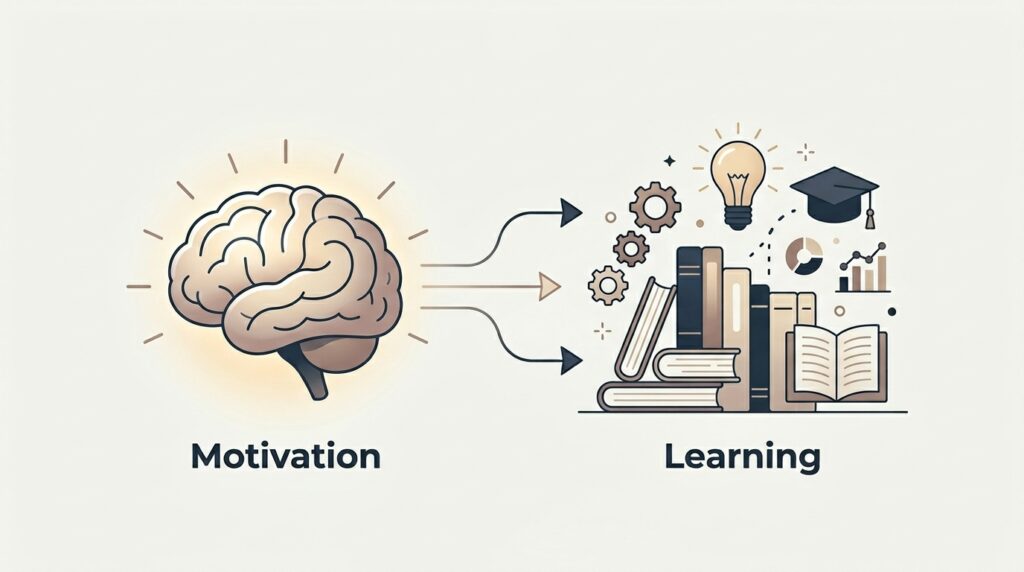
Basically, what I want to say is that when we study theories of motivation, we come across Hull, and when we study theories of learning, we encounter him again, because both are interconnected. I had explained properly how motivation and learning are connected, that learning will happen only because of motivation, both extrinsic and intrinsic. So, in today’s article, we’re going to explore every aspect of Hull’s Reinforcement Theory and Drive Reduction Model.
Introduction to Clark Hull
Clark Hull, his complete name. He was majorly influenced by Pavlov, Darwin, Thorndike, and Tolman’s theories. As he is influenced by them, people also call him an influential behaviorist. He is an American psychologist, and people also know him as a learning theorist.
His first book, in which his Hull theory was first published, was “Principles of Behavior,” 1943. This was not his first book, but he presented Hull’s theory for the first time in 1943 in this book. He later extended it in his last book, “A Behavior System” in 1952.
Understanding Drive and Motivation
This means that a state of tension or arousal is caused by biological or physiological needs. We have discussed while studying motivation that Needs are of two types:
- Physiological
- Secondary needs
We call these primary and secondary, and we also call them learned needs.
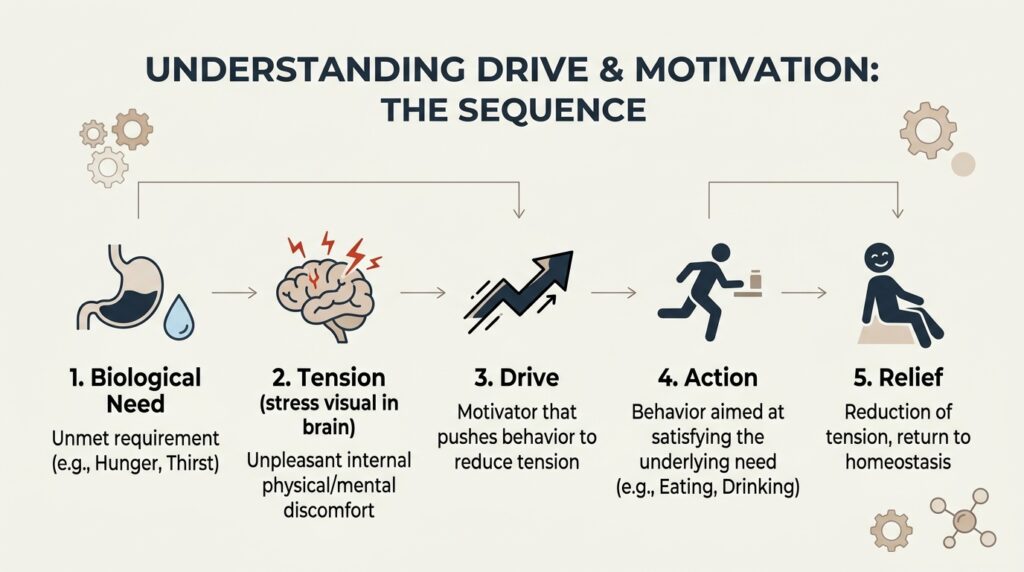
When biological or physiological needs remain unfulfilled, then the state of tension in your mind creates a drive. That means it creates a motivation that you do some work. So that will be a drive.
What does drive mean? The state of tension created is due to biological, physiological, or primary needs. The drive creates an unpleasant state, a tension that we need to reduce.
Types of Drives
He talked about two types of drives. We have already studied:
- primary drives
- secondary drives
But the point is that both types of drives create motivation. That means if there is anything, whether you have a secondary drive or a primary drive: In primary, things like food, clothing, shelter, and in secondary, you acquire learned drives, like hunger for power.
Drives are of two types, but Hull talked only about one type. He talked about only primary drives, that is, primary or physiological or biological needs create the drive, i.e., the tension created due to that he called drive. He did not talk about the secondary drive.
Concept of Homeostasis
Hull gave one more concept which you should know. The theory that he gave is based on the concept of homeostasis.
What is homeostasis, it is a kind of balance situation. If you have studied science, then you must have studied in class 10 that we call a balance or equilibrium situation, homeostasis, which our body uses to balance temperature and other things.
Hull’s Reinforcement Theory and Drive Reduction Model
The Hull model, i.e., reduction in drive, constitutes reinforcement of the S-R association, i.e., reinforcement of the association.
How will the association happen:
- stimulus
- organism
- response
That is when an organism gets a stimulus, it will respond to that stimulus. We have studied this in S-R association, and also in Thorndike.
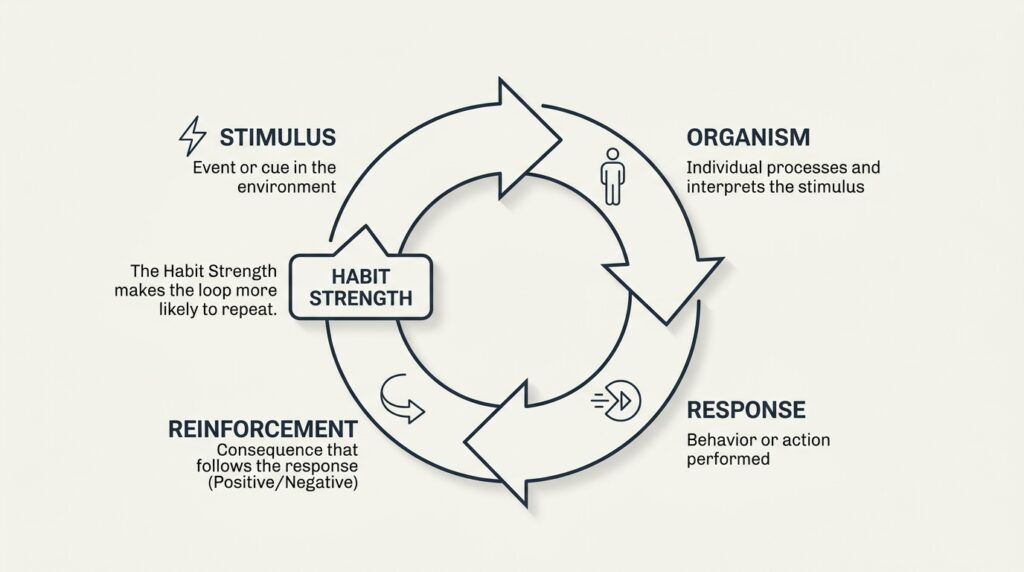
So the point is that when repetition of something happens, then due to reinforcement, it becomes a habit. So the habit strength will increase because the stimulus that you are getting again and again, you are responding to it, so it will become a habit.
Relation with Thorndike’s Law of Effect
Thorndike’s Law of Effect is compared with Hull’s Law of primary reinforcement.
Hull said that you will do that thing because you are getting the drive due to which you will do it, that is, there will be reinforcement when you do it again and again, right? So that thing is also related to Thorndike’s Law of Effect.
Reinforcement is the reduction of the drive state and any behavior associated with it. So, what will reinforcement be when you reduce the drive? Due to that, what happens is, suppose you feel hungry, so you have the desire to eat food, so that is a drive, you are getting motivation from inside to eat food.
So when you eat food, it will be reduced, due to which the behavior will be reinforced.
Behavior and Response
On what will response depend, on the characteristics of the stimulus and the organism.
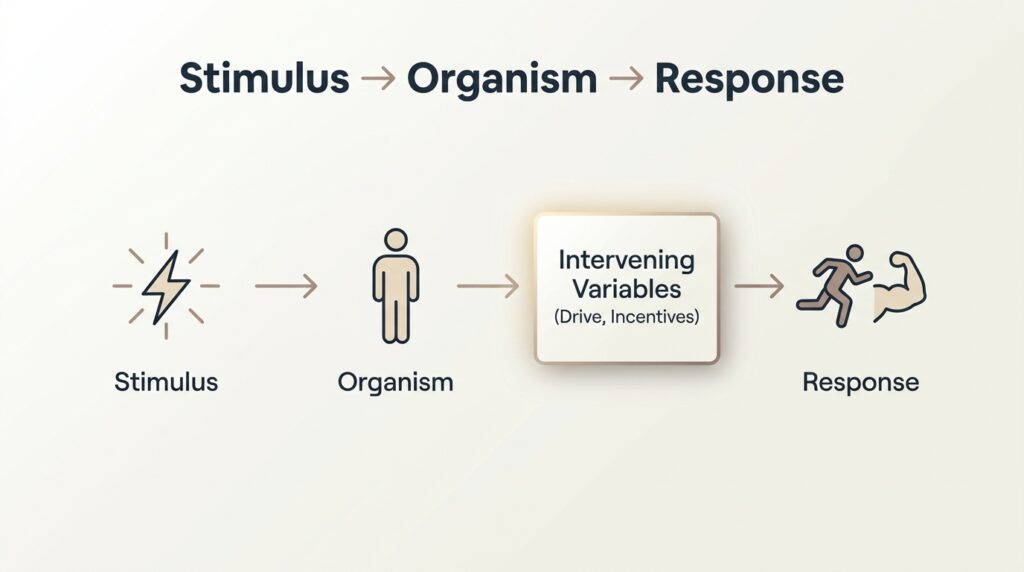
Hull was interested in studying intervening variables that affected behavior, such as initial drive or incentives, which affect behavior. He talked about studying those variables that affect behavior.
Hull’s drive reduction model becomes very important, and it is also called the.
Postulates of the Theory
He talked about three postulates:
- One, he said that there is a hierarchy of needs in the organism that are aroused under conditions of stimulation and drive.
- Habit strength, which will be aroused when you do that thing again and again.
- Stimuli are associated with the response, and the sensation of response becomes a conditioned inhibitor.
So he talked about these three theoretical frameworks. Mainly, we relate it to motivation because the drive reduction model is studied in motivation, and the reinforcement theory is studied in learning.
Process of Drive Reduction
Now, this was the drive reduction model, i.e., physiological drive, occur, and it gave us motivation. Due to that, we did the work and achieved something, which reduced the drive.
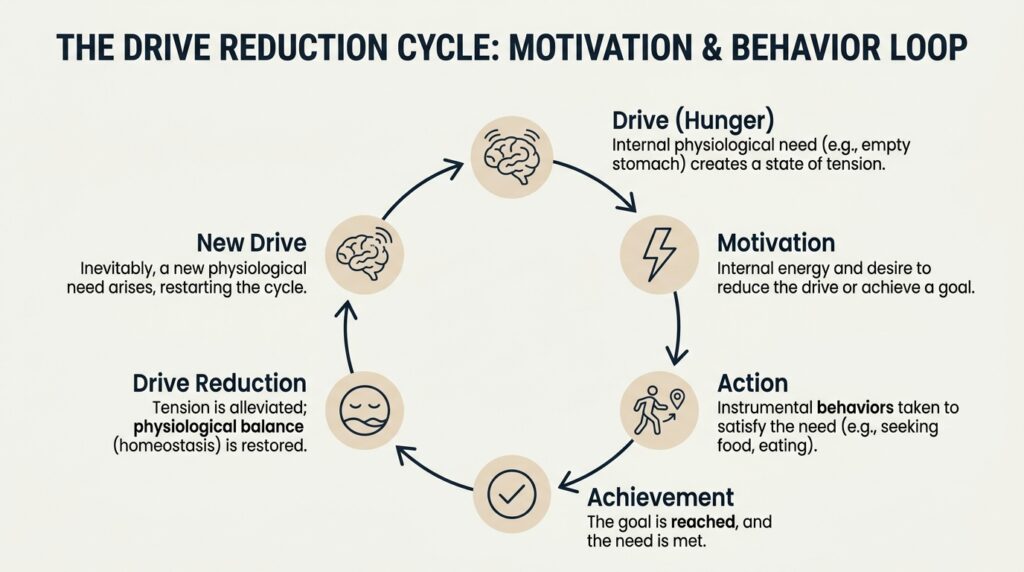
Then, further, we will get some other drive, and based on that drive, motivation will develop. We will try to achieve it, work towards it, and then after we fulfill it, the drive will again reduce.
So we are repeating things, so he explained reinforcement theory for learning.
Learning According to Hull
He did not give any importance to consciousness in learning; he gave importance to practice in learning, i.e., doing things again and again.
He presented a behaviorist and instrumentalist explanation of learning. According to him, learning means an organism learns to respond to a stimulus; we call learning the process of responding to a stimulus.
An organism learns gradually by practice. People also call his theory goal gradient or reinforcement gradient theory, and we can consider it a refined form of Thorndike’s Law of Effect. We’ve already discussed all the laws of Thorndike, which you can read later.
Reinforcement and Conditioning
So some books also write reinforcement as conditioning. Hull was a neo-behaviorist, but like other major behaviorists, he also believed that human behavior can be explained by conditioning or reinforcement.
The reduction in drive, i.e., when the drive reduces, reinforcement makes you do that work again. This reinforcement increases the likelihood that you will do that behavior again in the future when the same need arises.
Example of Drive Reduction
You felt hungry, okay, that hunger is a drive. You saw food or made it, or basically, you ate the food.
When you ate the food, you reduced the drive. Now, when the drive reduces, you get reinforcement that whenever you feel hungry, you have to eat food.
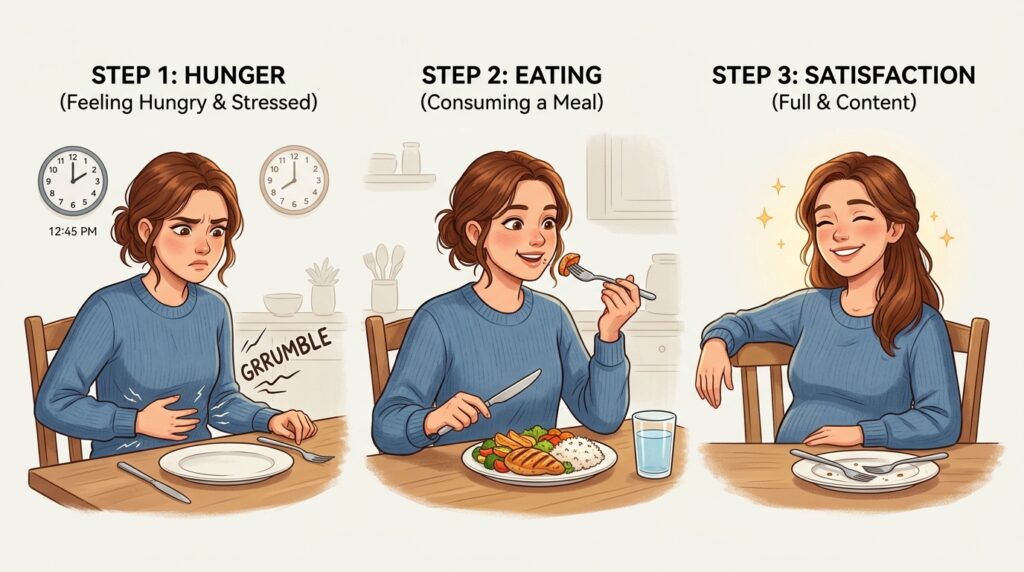
So reinforcement increases the likelihood of this cycle, so that when the same situation comes again, the same need arises, then you do the same thing.
Goal of the Theory
In order to survive in its environment, an organism must behave in a way that meets its survival needs. So you will behave in that way when you fulfill these needs or work on these needs.
Hull’s main goal was to create a formula to explain and understand human behavior, which, if you see in detail in some books, you will find mathematical explanations.
He wanted to develop a theory of learning that could mathematically explain human behavior properly.
Criticism of the Theory
His biggest problem, that is the problem of drive reduction theory, was that he did not include secondary reinforcement, that is, secondary needs. He talked only about primary reinforcement; he did not talk about secondary reinforcement.
The major criticism of the drive reduction theory of learning was that it does not explain why people engage in behaviors that do not reduce drives.
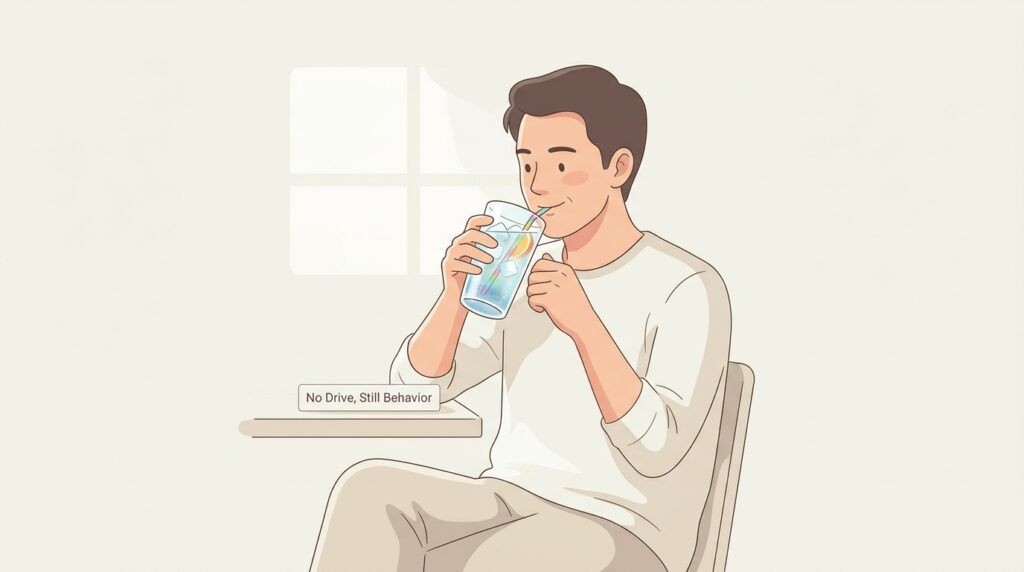
For example, people are not hungry, but they engage in behavior, like when you are not thirsty but still you drink a cold drink, right? So this comes under criticism.
Alternative Theory
Abraham Maslow, who is famous for the hierarchy of needs, gave it as an alternative that there is a hierarchy of needs that requires drive to fulfill.
Abraham Maslow further gave the hierarchy of needs. You can also read that article.
Stay connected with us!