
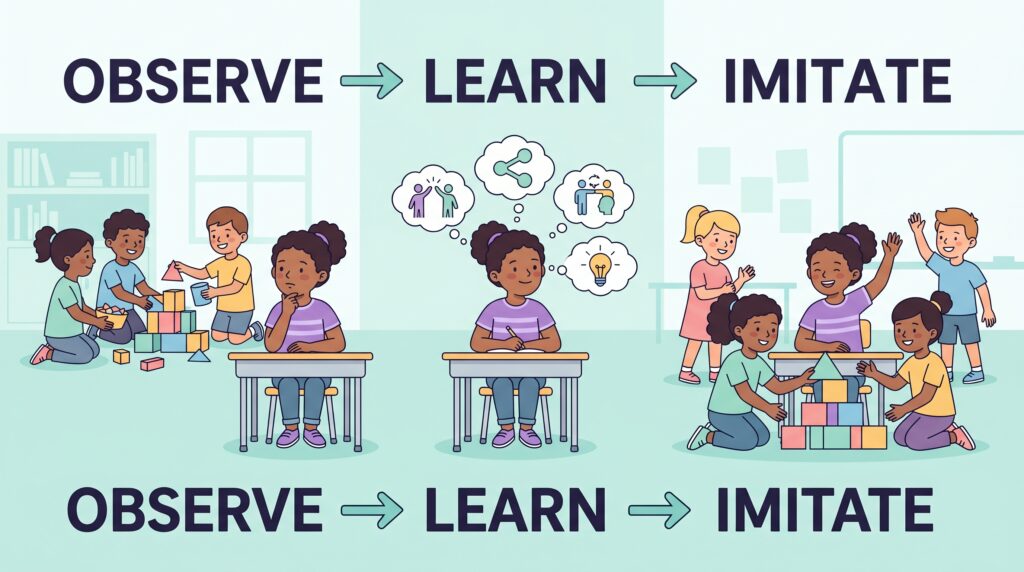
Social learning means that at the social level, we want to learn something. There are things at the social level that we observe. Because of that, we learn something.
These are prominent American learning theorists. They worked on learning and had their own particular theory. That is why we call them theorists.
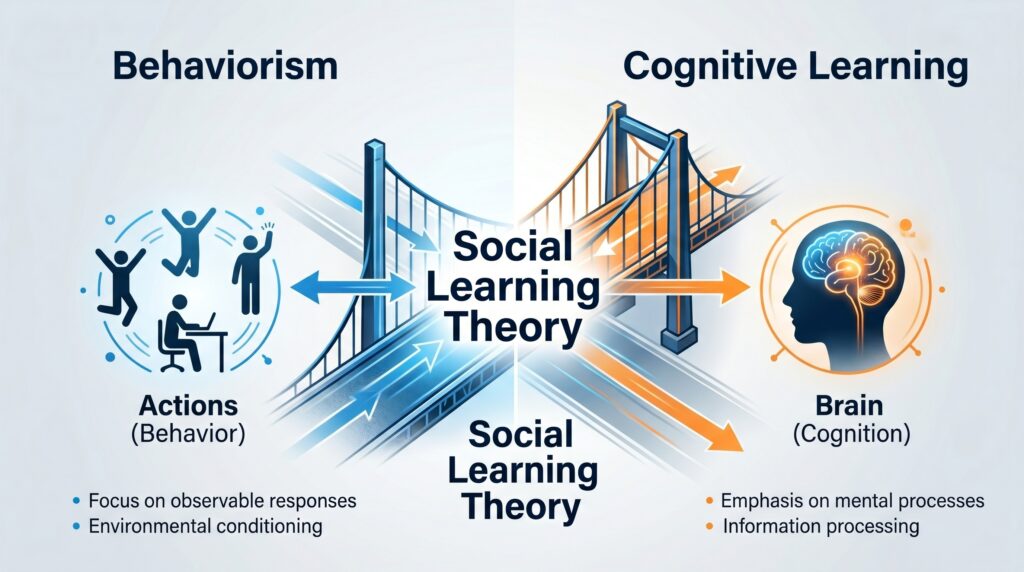
Learning in Social Learning Theory appeared many times in this time’s NET exam, so it becomes important, and you have to remember that Social Learning Theory works like a bridge. The question often asks how Albert Bandura’s theory works, so it works like a bridge between behavior and cognitive learning.
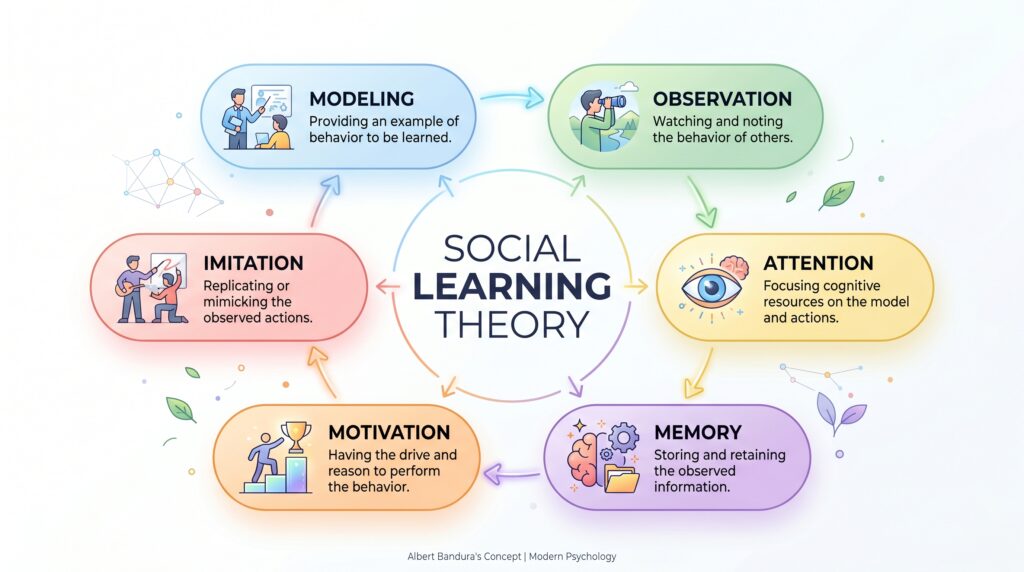
So, among these behaviorist theories and cognitive learning theories, which will work as a bridge? Social Learning Theory will work. Why will it work? Because it includes attention, memory, and motivation, all three things.
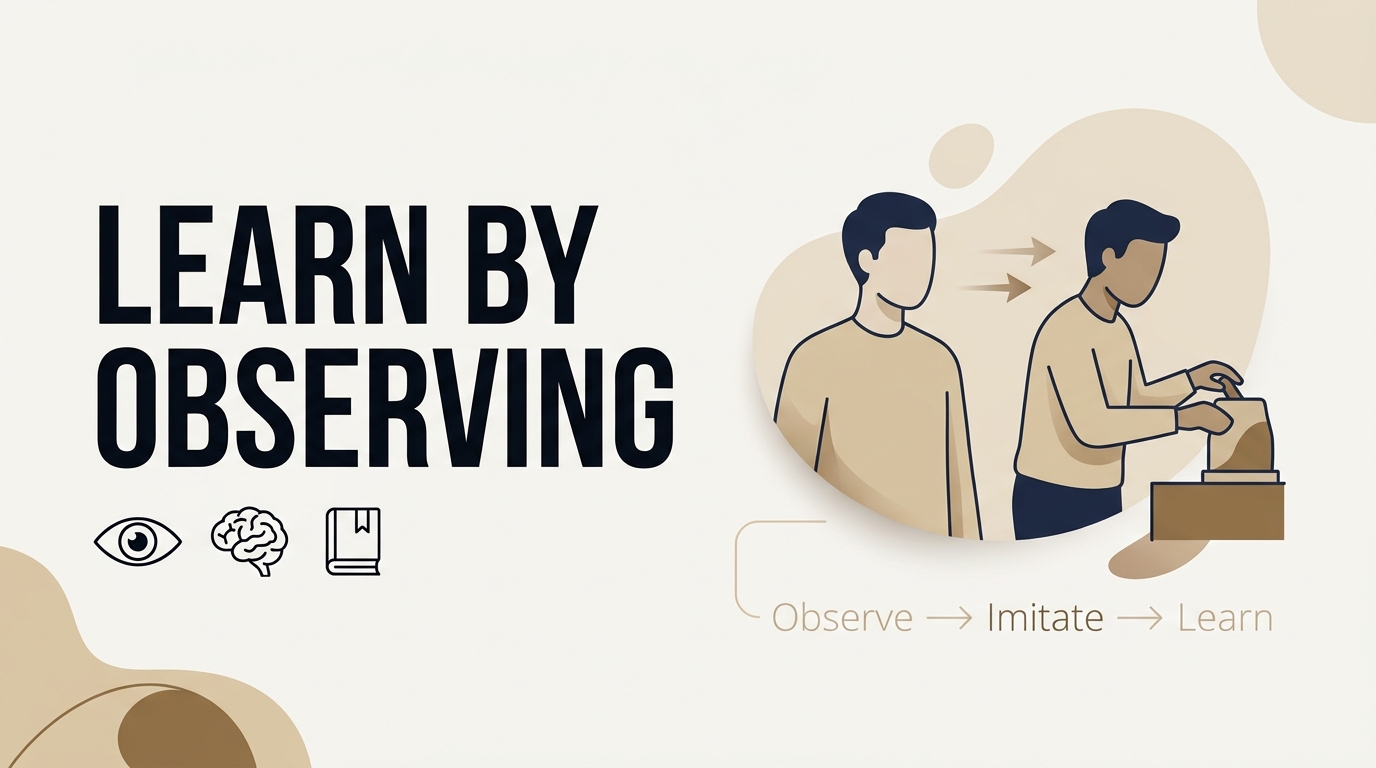
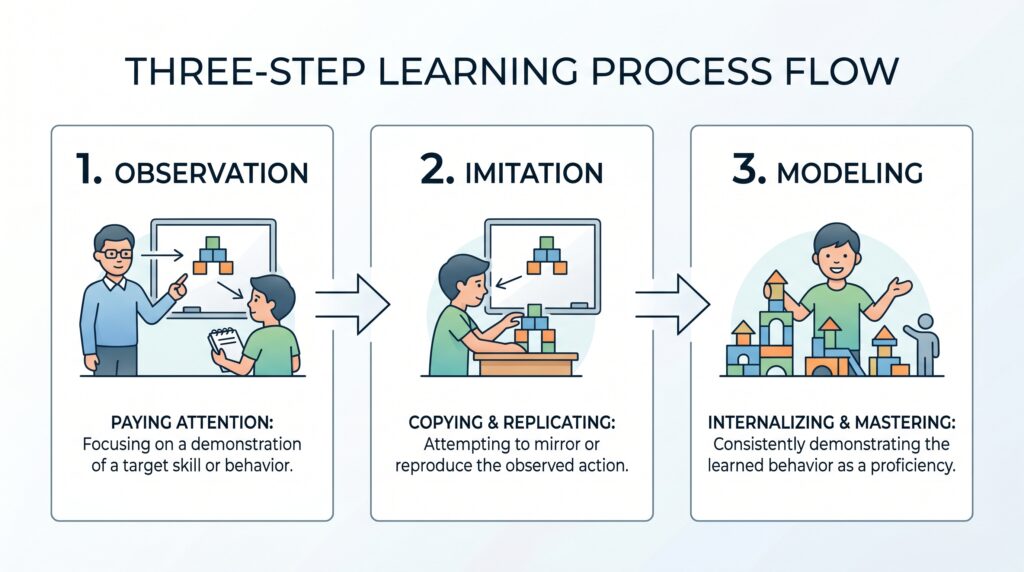
Theory explains that people learn from one another through observation, imitation, and modeling. So this line is exactly of this theory, which explains that a person learns from observation, learns by imitating, or learns through the process of modeling. So that learning, what are they calling it? Observational Learning Theory or Social Learning Theory.
Now, Albert Bandura, 1925 to 2021, gave the Social Learning Theory, and people also know him by the name Father of Cognitive Theory, so keep this thing in mind.
Core Concepts
If we talk about literature, then on its basis, three concepts we will see in Social Learning Theory:
Firstly, people can learn through observation, which is why we are calling it Observational Learning Theory, because it focuses on observational learning.
Second thing, the second concept that he talked about is of intrinsic reinforcement, that is, a mental state or the things that are intrinsic.
Intrinsic motivation and reinforcement are very important factors for any kind of learning. Meaning I will want to learn something from inside, only then I will start learning, right?
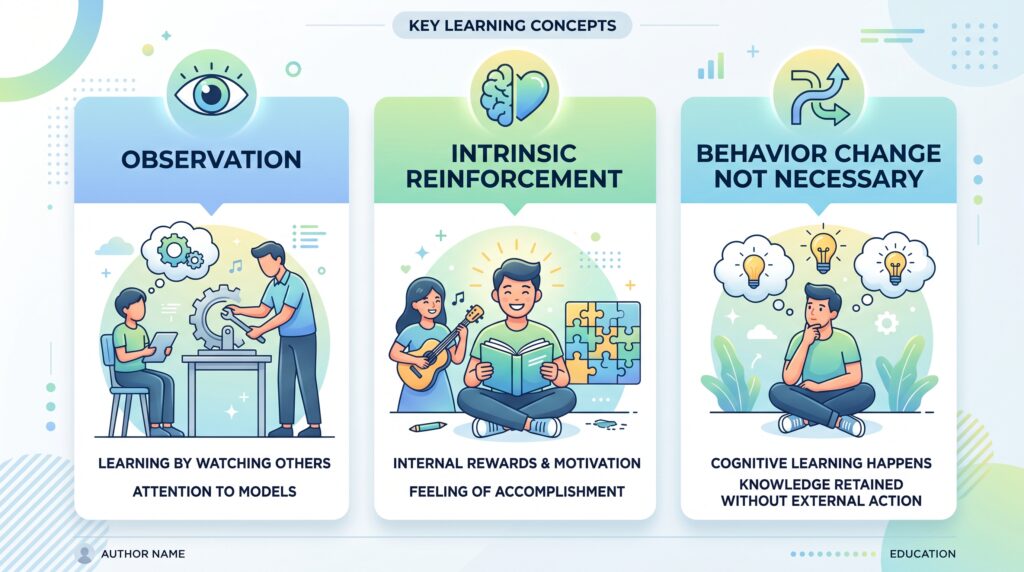
So learning of any type, an intrinsic motivation or a mental state, is very necessary, which here they are using the word intrinsic reinforcement.
Finally, it refers to this finding that learning does not necessarily lead to a change in behavior. Usually, we say that learning brings some change in behavior, but here it is saying that it is not necessary, meaning change doesn’t need to definitely come in behavior, and it is followed by the modeling process.
So the modeling process is defined here. If I talk about 1986, then Bandura, based on other studies and findings, renamed Social Learning Theory as Social Cognitive Learning Theory, or SLT.
If you find Social Cognitive Learning Theory anywhere, then that is also the same. From here, Social Learning Theory, Observational Theory, we only call it that, right, yes, NCERT.
Bandura’s Statement on Learning
About Social Learning Theory, meaning Albert Bandura’s particular words, what were his quoted statements? He said that most human behavior develops through observation and modeling. By observing others, one forms an idea of how new behaviors work. On later occasions, we reuse the same things which we learned by recalling them.e the same things which we learned by recalling them.
So he has basically defined the process of modeling in such a way that, through observation, people learn observational learning through the process of modeling.
Bobo Doll Experiment
To explain this process of modeling, or to explain this theory, Albert Bandura demonstrated it on some children. The children who are learning by imitating behavior are learning by observing other people. For this, he gave the Bobo Doll experiment.
What is Bobo Doll? It is a kind of doll, meaning you can assume that if you hit it, it will take it in a fluffy way, as it bounces back, and then it will fall and again stand up, so like that, you can assume a cartoon type.
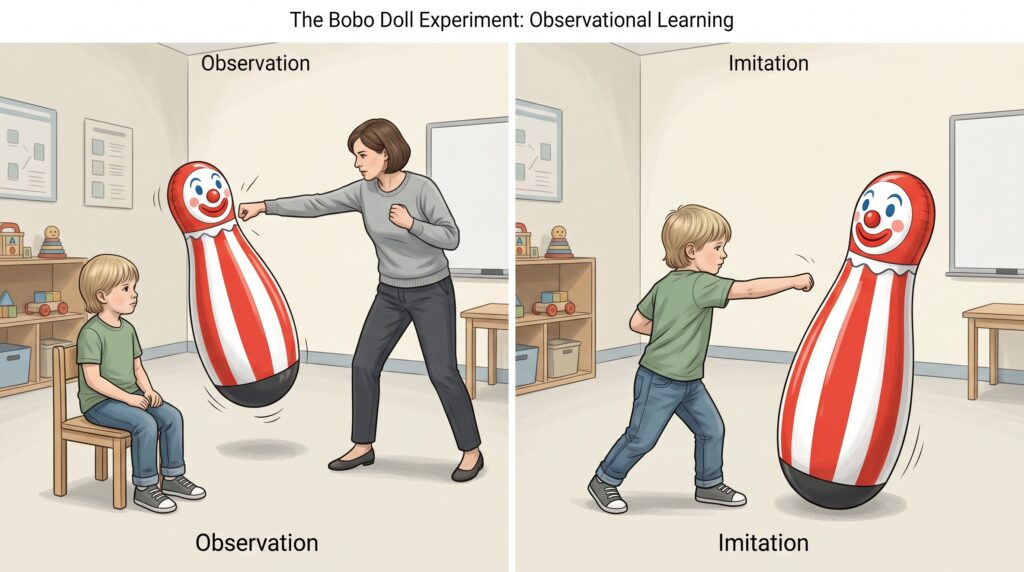
So he used it in the experiment, and what he did was he observed, meaning where the Bobo Doll was kept, on the side, children were made to sit, meaning the children were observing that thing.
What did the children observe? – Some adults are attacking those dolls, meaning they are hitting them.
Basically, we want to show that adults display aggressive behavior. You can assume that in a house, suppose someone’s parents—this happens in many places—that after drinking, the father commits violence at home. Children also follow that aggressive behavior. The children learn it by seeing it. Many times, people say that if you do this, then how will your children learn?
So that thing is here, that adults are attacking those Bobo dolls. When they hit them, those dolls fall, then they bounce back and stand up again. After seeing all this, the instructor allowed the children to be in a room where the Bobo doll is kept, and they can play there.
So they imitated that behavior. If the adult was hitting the doll, then they also punched it. The adults showed aggressive behavior. The children observed it. The children showed the same behavior here.
But one more thing we observed. When the children saw that if the parent or that adult hits them and shows aggressive behavior, then they get punishment for it. We also showed this by hinting. Then the children understood that no, this thing should not be done.
So what did Bandura notice? That children do not imitate aggressive behavior themselves so much, meaning very few would have done such things; otherwise, they did not imitate that behavior, they did not learn from there.
Basically, by observing how children are learning. When they observed hitting, then okay, but after hitting, if punishment is received, then they do not show that aggressive behavior again. So this was the Bobo Doll experiment.
The person whose behavior another person observes and often imitates becomes a model. Here that adult works as a model because children learn by seeing them. The one from whom learning happens becomes a kind of model.
This process is observational learning. You observe and learn by seeing someone. So this becomes the process of modeling.
Conclusion
Social Learning Theory explains that people learn through observation, imitation, and modeling. It works as a bridge between behaviorist and cognitive learning by including attention, memory, and motivation. The Bobo Doll experiment clearly shows how children imitate behaviors they observe, especially aggressive actions. The four principles—attention, retention, reproduction, and motivation—define the complete learning process. Reinforcement and punishment play an important role in shaping behavior. Various personal, social, and environmental factors also influence learning. Overall, this theory highlights that learning does not always lead to behavior change but depends on multiple conditions.