
Before jumping straight into definitions, just think about your daily life for a second. A lot of times, we learn things without even realizing it. Our brain keeps connecting small things—sounds, actions, reactions—and slowly, those connections turn into habits. You don’t consciously try, it just happens naturally. That’s exactly what classical conditioning is all about.
In this article, we’re going to understand classical conditioning in a very simple and natural way—what it actually means, how it works, and why it even matters. We’ll also look at the famous experiment behind it. And more importantly, see how this idea isn’t just a theory, but something that is already happening around us in everyday life without us even noticing.
Pavlov’s father was a priest. He was a Russian scientist. There was a problem that his father’s profession was completely different from his own, because he became a great scientist. His training was in physiology and medicine; that is, he had done an MD, had done a master’s in medicine, doctorate, sorry.
Personal Life and Support System
Then comes that his wife was a student, he married her. After marriage, for some time, John had to stay away from his wife. Despite staying apart, the dedication towards his work and his wife’s support—this kind of support that whatever you feel like doing, do it, follow your interest—so this support his wife showed, that he worked for hours, and she supported him. She used to say that your work is important. Because of this support, John got success, and for this, he gives credit to his wife. His wife was a domestic manager who dedicated her entire life to Pavlov’s work and his comfort.
Nobel Prize and Contribution
Then it came that in 1904, after doing so much work throughout his life, he received the Nobel Prize in Physiology or Medicine. His work was related to digestion, and that dedicated work got recognition, because of which he received the Nobel Prize. But for what he is mainly known, basically, he is known in psychology; he is known for the theory of classical conditioning. From his work on digestion, he derived a new concept, which is classical conditioning. So his main work was that for which he got the Nobel Prize, and from that only, when this work was published properly, then what came out was the theory of classical conditioning.
Overview and Terminology
Classical conditioning can also be called respondent conditioning, you may also get conditioned reflex, or Pavlovian conditioning. It is also called a conditioned response. You have to remember what other names it can have. Now, because of this experiment, this theory revolves around this experiment, which we should know. You just have to remember that Pavlov’s dog experiment is there. If you remember this one line, then you will understand the whole scenario.
Pavlov’s Dog Experiment
He did the experiment on dogs because he was working on dogs. He worked on more than 40 dogs. So if sometimes an objective question comes that what was the name of Pavlov’s dog, then it becomes a bit confusing because he worked on more than 40 dogs and all had different names. So there is no need to remember the name of a particular dog.
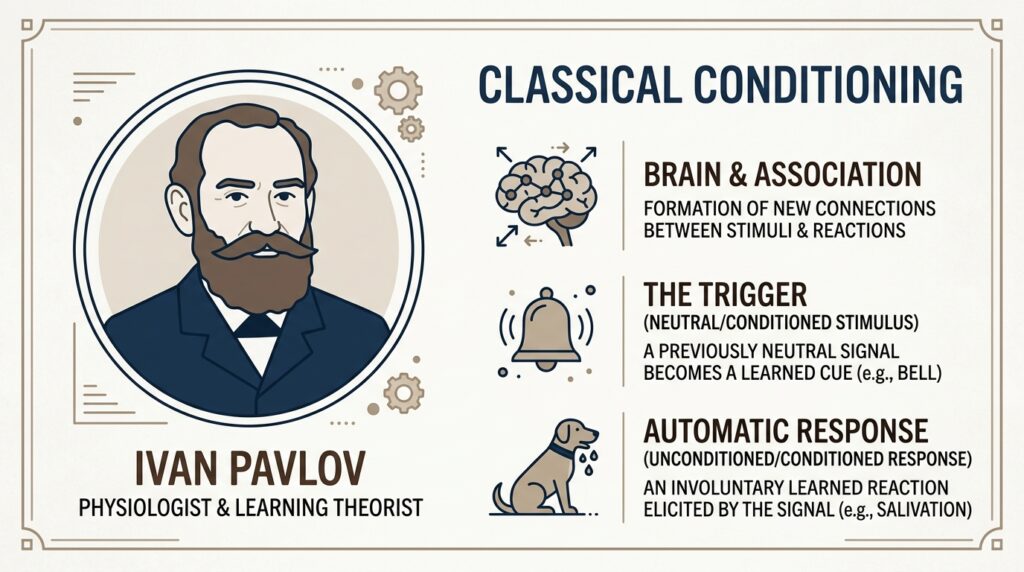
Now, what he did to the dogs was that since his work on digestion was already going on, he used saliva secretion as a measure. When food is seen, saliva is secreted in the mouth. He used the quantity of saliva as a measure, meaning he collected that saliva and measured how much saliva was produced, and on that basis, he did the experiment.
He tied the dog with a harness so that its movement remains restricted and it cannot go anywhere. A tube was attached, which would collect the saliva of the dog. Now, the saliva work here is that food is placed, saliva comes, and how much saliva comes, that quantity is measured. After that, he connected conditioning, meaning he paired things.
Conditioning Process
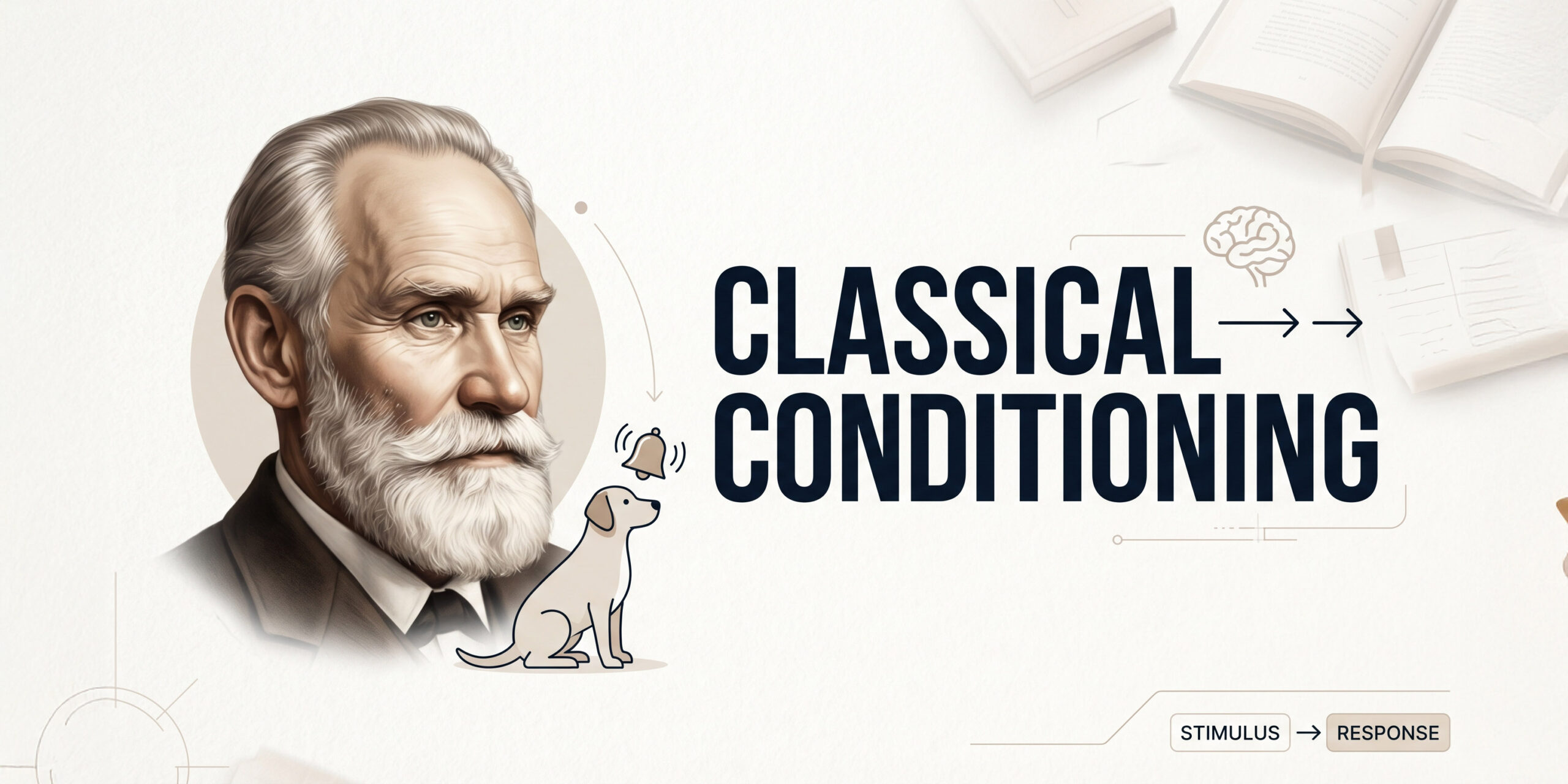
Now, what happens in this is that you taught something, you activated it, and seeing that, a response is received. When the dog sees food, saliva comes out of its mouth. He collected that saliva. Then he conditioned it. Before giving food, he started ringing a bell. Basically, he gave a sound first, then food was given.
So the conditioning of the dog became that when this process was repeated, first the bell was rung, and then food was given. When this process kept repeating, a point came when, just by ringing the bell, saliva started being produced. Because the dog recognized that after this bell, it would get food.
So this experiment shows that as you condition the dog, by adding the bell in its conditioning, because of the bell, a natural response is coming, saliva is coming. So this is the whole experiment.
Principles of Classical Conditioning
Now, related to this experiment, four things we should know, which are called principles. When you write an answer, you have to mention these.
- First, the unconditioned stimulus, that is, food. It automatically activates a response.
- When food is given to the dog, the food becomes the unconditioned stimulus, and seeing it, saliva is produced.
- So saliva is the unconditioned response. This is unintentional, meaning it is an automatic reaction.
Now, in this condition, what happened is that the neutral stimulus, which had nothing to do with it, was connected with it. Then the bell became the conditioned stimulus, because we conditioned that signal by repeating it. After that, a natural response started coming. So this became a conditioned stimulus with a conditioned response.
Levels of Classical Conditioning
Now, remember the levels of classical conditioning properly.
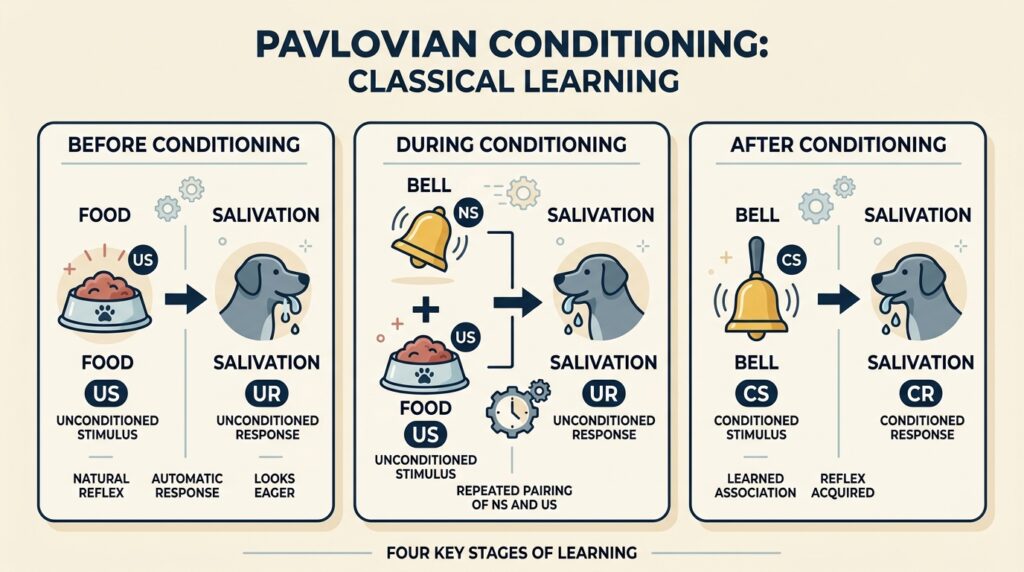
Before Conditioning
- We give food to the dog, and saliva is produced.
- The unconditioned stimulus is food
- Unconditioned response is saliva
- A neutral stimulus has no effect
During Conditioning
- An unconditioned stimulus is paired with a neutral stimulus
- Unconditioned response is saliva
- A neutral stimulus alone does nothing
- When we keep pairing and repeating, that is the conditioning phase
After Conditioning
- The conditioned stimulus (which was once neutral) alone produces the conditioned response (saliva)
Here, the stimulus is artificial because instead of food, the bell is used, but still, the natural response comes out. So these three levels in classical conditioning must be remembered.
Key Concepts and Definitions
Now, under this, you will find many definitions:
- Acquisition: meaning the dog acquires the conditioned response.
- Generalization: where similar situations produce the same response. If the dog generalizes, then similar sounds may also produce saliva.
- Discrimination: where it learns to differentiate between different stimuli.
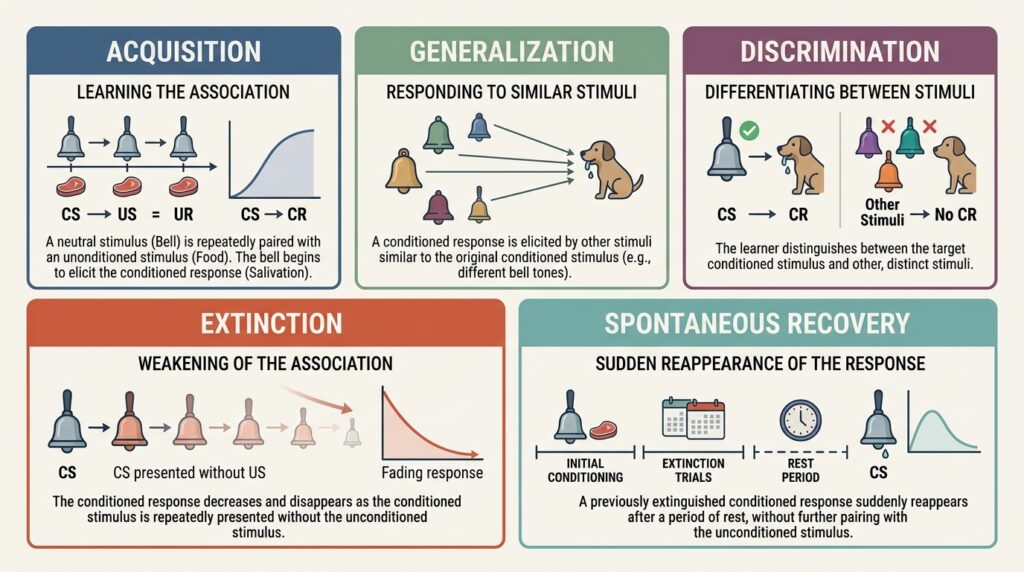
Then, suppose for some time you stop repeating the process and directly give food, then the dog may forget that after the bell, food comes. So it may stop responding to the bell. This is extinction.
Then, spontaneous recovery, after some time, suddenly, if the bell sound is heard again and saliva comes, then that is spontaneous recovery, meaning the conditioning comes back again.
So you have to understand the names of these processes. Their meaning is hidden in the word itself, whether in Hindi or English.
Educational Application
Now, an educational application is that through conditioning, you can shape any student. During conditioning, the role of teachers and parents becomes important. A child can be conditioned in the way you want.
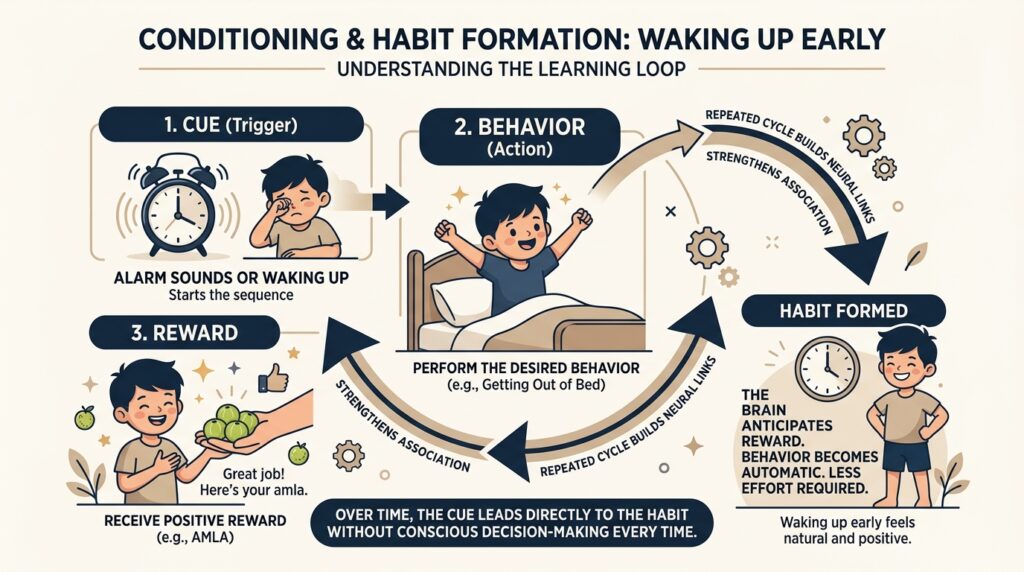
For example, if you want to develop the habit of waking up early, then you have to make yourself wake up. You can give some incentive. If a child likes amla very much and you give amla in the morning when they wake up, then it becomes a conditioning that as soon as you give amla, the child wakes up.
Similarly, you can condition a child for studies or household work. Teachers and parents can use this conditioning in education, at home, or in school.
Stay connected with us!