
ITEP (Integrated Teachers Education Program) has created a lot of confusion in students’ minds—what it is, what benefits we will get, and why we should pursue it. Also, who is eligible, what kind of test will be conducted, and how you can secure your seat—today, in this article, We’ll clear all these doubts.
What is ITEP?
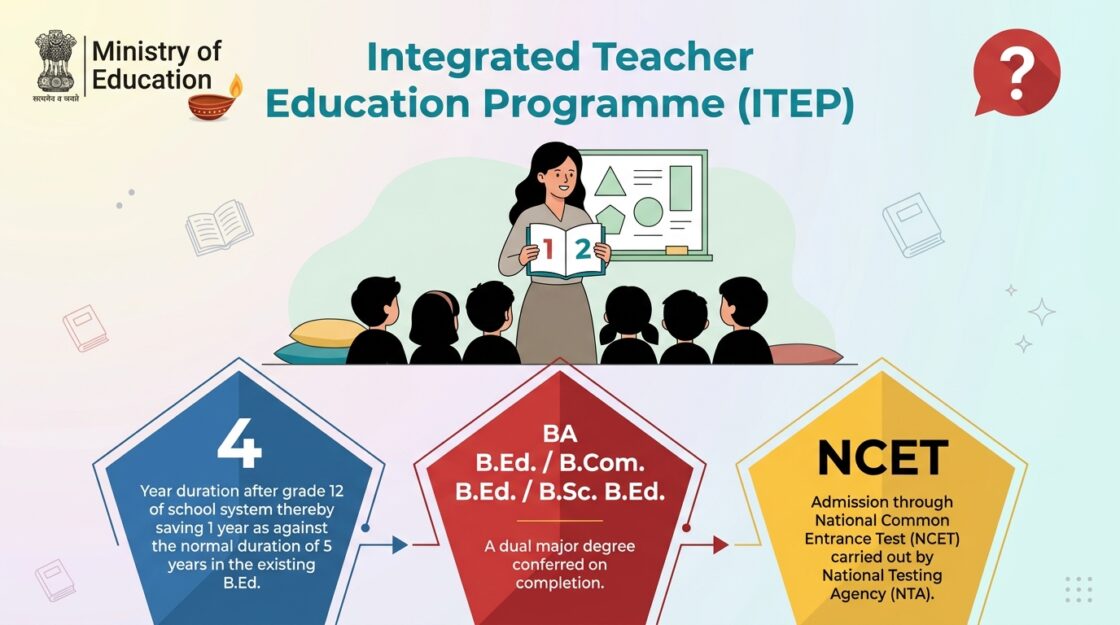
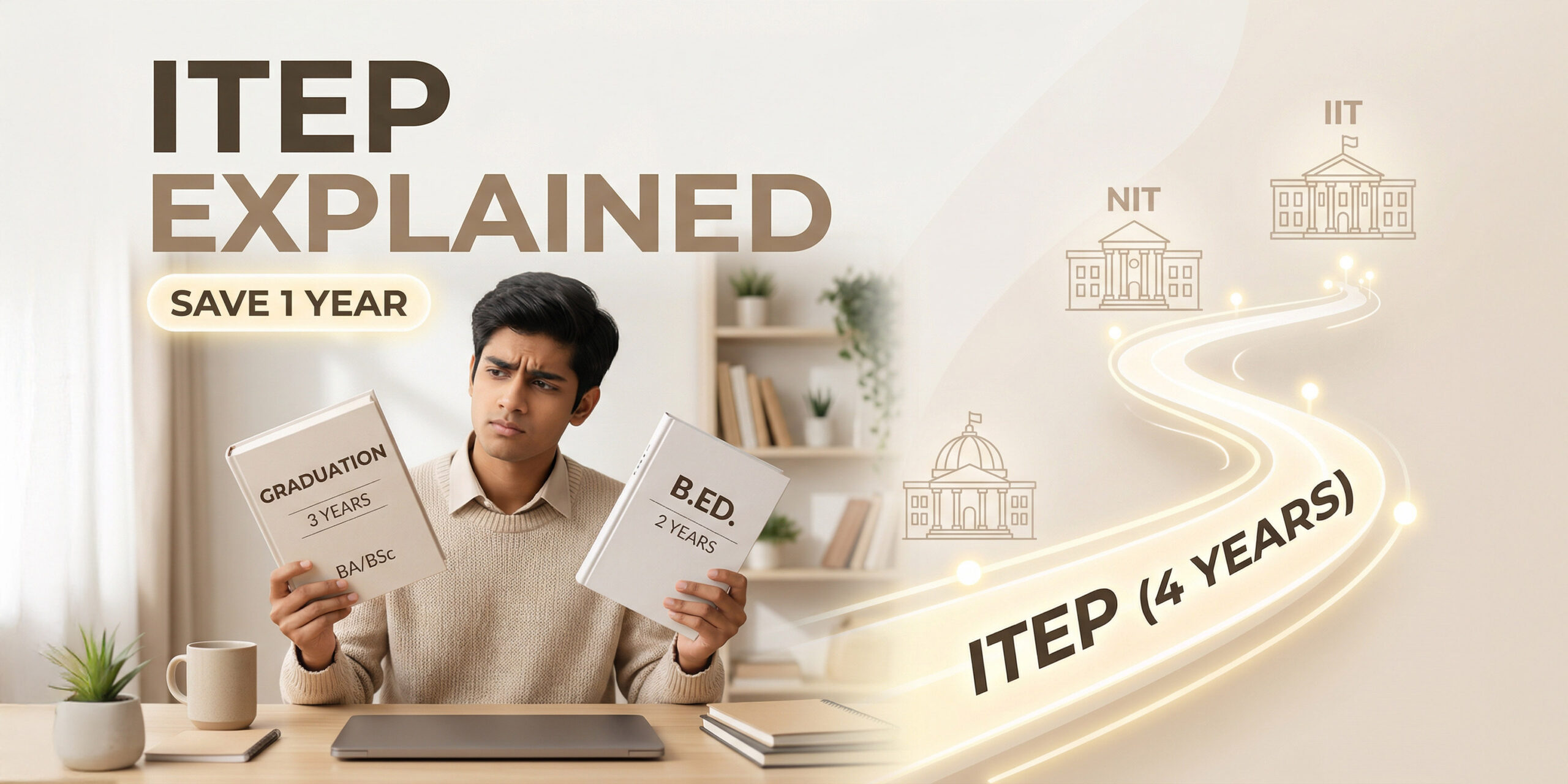
First, let’s understand what ITEP is. It is a 4-year program that has been running earlier as well. For example, if you combine your graduation and a 2-year B.Ed, it becomes 4 years. Similarly, there are many such courses in our country like BA LLB. What happens here is that you will do your graduation and B.Ed together, saving one year.
Along with this, based on your graduation, you can apply anywhere—like UPSC, SSC, or any government job in your state government. Your graduation degree will remain valid. At the same time, based on the B.Ed you complete in these four years, you can become a teacher.
Teaching Levels and Flexibility
Now, another confusion students have is: after doing B.Ed, can we become primary teachers? Can we teach nursery-level students? Or can we teach secondary-level students? So, you will have a choice. According to our education system, the structure is divided into sections based on age groups—Foundational, Preparatory, Middle, and Secondary. You can choose whichever level you want to become a teacher in. You will have the freedom to decide this.
Dual Degree and Subject Choices
So, this is ITEP—a 4-year integrated program, meaning a mixed program in which you will get a dual degree. You will get a B.Ed degree to become a teacher, and also a graduation degree. You can do your graduation in BA, B.Com, or B.Sc. You will also have many subject choices to choose from.
Participating Institutions and Seats
Where will you get admission? Initially, it has been started in selected and top institutions of the country like IITs, NITs, Delhi University, Punjab University, and many other colleges where you can take admission. Currently, there are more than 6000 seats available for admission.
Admission Process
Now let’s understand the admission process. To take admission, you have to give an exam called NCT (National Common Entrance Test). You can apply for this test based on your 12th. Age is not a factor—there is no minimum or maximum age limit. Anyone who has passed 12th, regardless of when, can apply.
Exam Pattern
Now lets discuss about the exam pattern, it is divided into sections.
First, you have to select two languages—whatever you studied at school level, like Hindi, English, Sanskrit, or even your regional language. You have to choose Language 1 and Language 2, and you cannot repeat the same language in both.
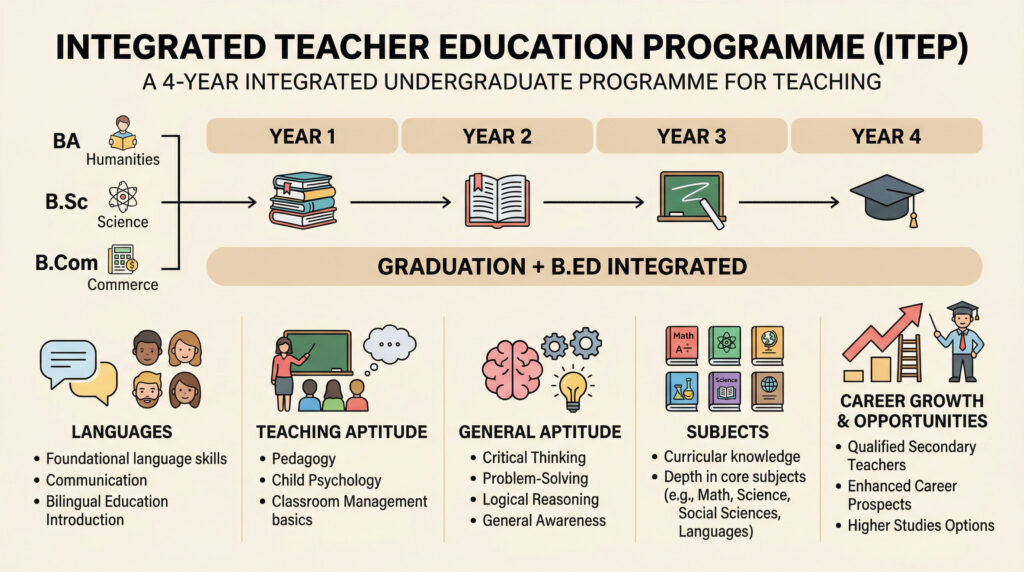
After this comes the Teaching Aptitude section—this includes basic application-based questions related to how a teacher behaves, teaches in class, and handles situations.
Now the next section General Test, which includes basic GK, reasoning, and maths—similar to what is asked in CUET and other UG entrance exams.
Then comes the Subject section, where you have to select three subjects based on your 12th. For example, if you studied History, English, and Hindi, you can choose from among 26 subjects available. There is no restriction that you must choose subjects only from your stream. Even a science student can choose BA subjects, so you have full freedom here.
Exam Mode and Timing
Now coming to the last point—how and when will the exam be conducted. The forms are already out and are being filled. The exam will be computer-based, meaning online. You will sit in front of a computer, questions will appear on the screen, and you have to answer them. It is not an offline pen-and-paper test.
Who Should Apply?
Now, who should do this and who should not? Students who are very high in age are not advised to go for this program. But students under 25 can definitely consider it. If you already have a graduation degree, that’s fine—you can do another graduation in a different subject, opening a new stream for you, along with completing your B.Ed.
Students who are older should focus on the traditional 2-year B.Ed. But students who are younger, have just passed 12th this year or last year, and want admission in top institutes like IITs—but usually don’t get it—this is a great opportunity. You can get a graduation degree from IIT along with a B.Ed.
Career Advantages
Not only will you get a degree from a top institutes like IITs, NITs, and Delhi University, but when you apply to private schools or institutions with your B.Ed, you will get more preference and a higher salary compared to those who have done B.Ed from normal colleges. It goes without saying that students from IITs, NITs, and Delhi University are considered at a different level.
Counseling and Selection Process
So this is ITEP, and the entrance exam for it is NCET. To get admission, you have to take this exam. Based on your scorecard, counseling will be conducted college-wise, just like in exams such as JEE or NEET.
Support and Preparation
If you want help at every step—from form filling to securing your seat—Teacher Adda will help you at every level. For the help part, you need to take one step forward. Along with that, classes will also be provided for your three selected subjects, teaching aptitude, languages, and general aptitude, so that you can score well, get a good rank, and secure admission in the best colleges.
Final Note
Since the number of seats in each college is limited, if you want to secure your seat in IITs, NITs, DU, and other top colleges, make sure you start preparing earlier to get into IITs, NITs. You can complete you IIT dream, if you’re not able to crack JEE Advanced.