
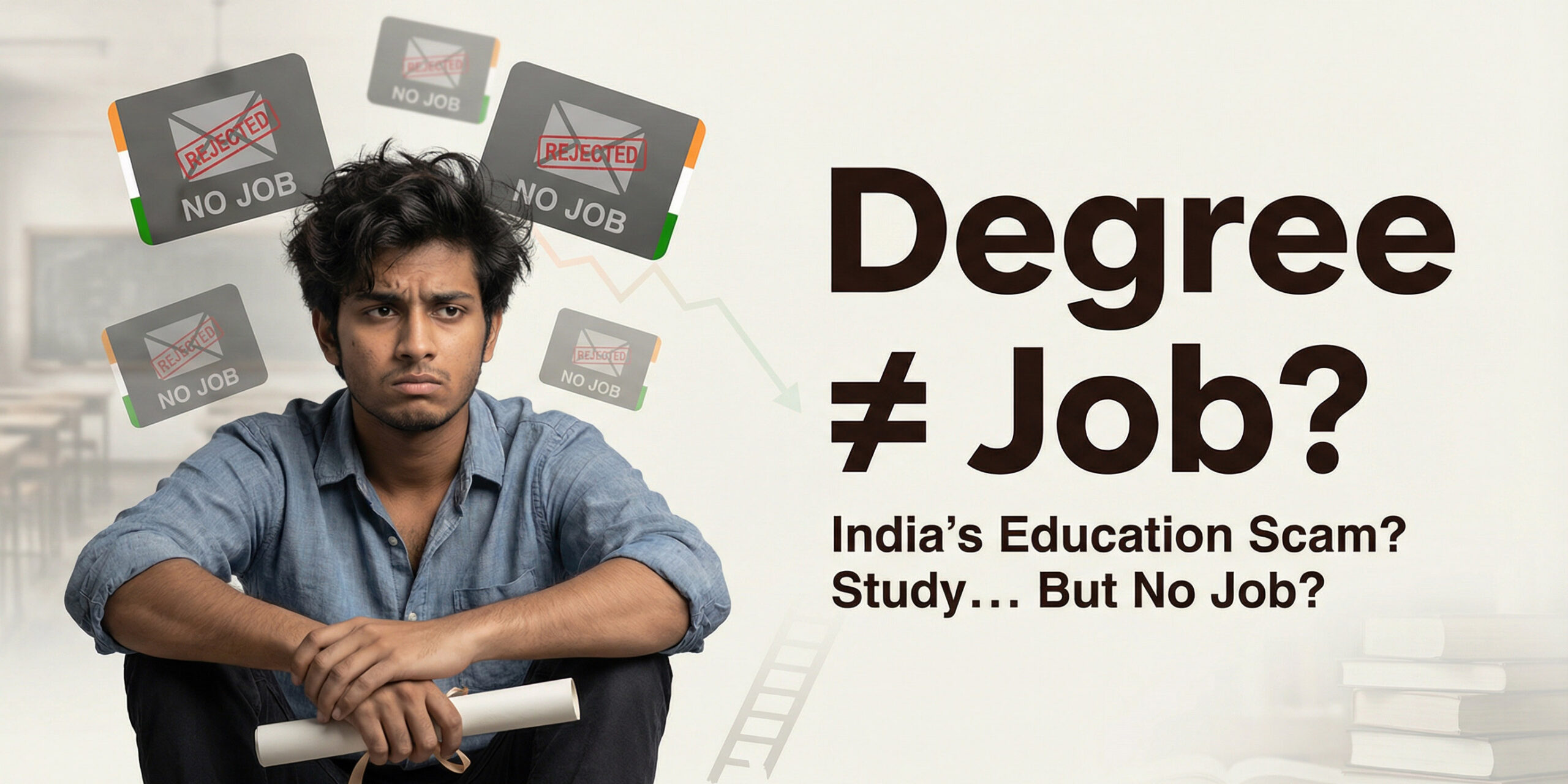
Today, India is struggling severely with the problem of unemployment.
And the biggest reason behind this is the Indian education system.
A large number of Indian youth are out of work. It is said that about 65% of the youth in India are jobless. Around 83% of the jobless workforce in India is under 34 years of age.
An Education System That Prepares Students Only to Pass
This is a system that teaches students how to pass exams but forgets to prepare them for the real world.
Consider the story of a 23-year-old student. After completing an engineering degree from a college in Pune, it was expected that all struggles would end—four years of hard work, tuition loans, sleepless nights of coding and assignments—all would finally pay off.
There was hope of getting a good job and solving all problems. But that did not happen.
Even one year after getting the degree, there is still no job. Now, back at home, preparation for another competitive exam continues, without any guarantee that it will even be conducted fairly.
This is not just one story. There are lakhs of such students.
Every year, around 30 lakh graduates enter the job market in India with their dreams. Out of them, more than half are not even ready for jobs.
This means:
- Everyone has a degree
- But they do not have the skills required by companies
As a result, lakhs of graduates remain unemployed, and job opportunities pass by them.
According to the India Skills Report 2025:
- Only 54.8% graduates are job-ready
According to CMIE data:
- 44.5% of youth aged 20–24 are unemployed
This is not just a number, but a reality that directly affects lakhs of middle-class families.
Students remain trapped in the cycle of exams, and even before their careers begin, their dreams start fading.
The education system that should move the country forward is instead pulling it backward, because it has become a loop in which youth are getting trapped.
Outdated Curriculum and Rote Learning
The current education system is still stuck in:
- Outdated curriculum
- Rote learning
Students mostly memorize things without understanding. There is no focus on how much they have actually learned.
Understanding is not emphasized. This habit has become so deep-rooted that in schools and colleges, studying seems to mean only one thing—passing exams.
It is only checked how much a student remembers, not whether they understand the concept.
Because of this:
- Student growth gets restricted
- They cannot connect ideas
- Even after getting degrees, they do not know what to do with them
As a result, they face difficulties in solving real-life problems, and companies do not prefer such candidates.
Exam-Oriented System
The biggest reason behind this problem is that the system is completely exam-oriented.
Whether it is:
- Class 10th or 12th board exams
- College exams
- Competitive exams
In all cases, evaluation is based on:
- Ability to recall facts
Teacher-Centered Classrooms
Another reason is that classrooms are mostly teacher-centered.
- Teachers are considered the main source of knowledge
- Students are expected to listen silently
While teacher knowledge is important, it should also be seen how much students are interacting in class.
However:
- There is no space for questioning
- There is no space for discussion
In such an environment, if students develop a habit of rote learning, their growth is limited.
Lack of Resources
A major issue is the lack of resources.
- In many rural schools, there is a shortage of teachers
- In some cases, one teacher handles more than 47 students
There is also the issue of contractual jobs:
- Many teachers do not have job security
- Around 69% of teachers in private schools do not have permanent contracts
- Even in government schools, many teachers are in insecure jobs
Because of this:
- Teachers lack motivation
- They are often looking for other jobs
- They cannot give their best
It is estimated that:
- Around 25% of teachers are absent daily
- In some states, this number is even higher
Poor Infrastructure
Out of 1.47 million schools in India:
- Only 65% have computers
- Out of those, only 58% computers are functional
- Only 63% schools have internet access
Government schools are in even worse condition, with very limited or unusable facilities.
Policy-Level Issues
At the policy level, conditions are also not very good.
The central and state governments promised to increase investment in education to:
- 6% of GDP
But even after several years:
- Spending remains around 4% to 4.6% of GDP
Commercialization and Corruption
Commercialization and corruption have further worsened the system.
- Private colleges charge high fees and donations
- Many institutions operate under political influence
Where political connections are strong:
- Private institutions grow rapidly
- But not in quality, only in revenue
As a result:
- Degrees are obtained
- But their real value remains low
Today, education has become one of the most successful businesses of the 21st century, where the focus is on generating money rather than ensuring quality and affordability.
Gurukul System vs Modern System
It is not that rote learning existed from the beginning in India.
Earlier, India had the Gurukul system:
- Students lived with their teachers in natural or isolated environments
- Education included both knowledge and life skills
Students learned:
- Discipline
- Respect for teachers
- Self-reliance
- Helping others
Education focused on:
- Overall development
- Thinking ability
- Character building
- Daily life skills
Shift After 1835
In 1835, Thomas Babington Macaulay introduced a major change through the “Minute on Indian Education.”
The idea was to:
- Replace Sanskrit and Arabic education with English education
- Create a class of Indians who were Indian by blood but English in thinking
This led to:
- Implementation of English Education Act (1835)
- Replacement of traditional education system
As a result:
- Gurukul system declined
- Classical languages lost importance
- A working class was developed through English education
This shift had a long-term impact on Indian culture and society.
Even today, schools follow an exam-centric model, focusing on passing rather than overall development.
Mental Pressure on Students
Because of this system, students face fear and pressure related to exams.
According to 2022 data:
- Around 13,000 students in India die by suicide every year
Major reasons include:
- Academic pressure
- Social stress
- Lack of support and awareness in schools and colleges
Role of Parents and Society
Parents and society also contribute to the problem.
Success is often defined as:
- Becoming a doctor
- Becoming an engineer
- Getting a government job
Because of this:
- Students are forced into these paths
- Coaching industries have grown rapidly
These coaching centers have become factories preparing students only for exams.
Reality of Competitive Exams
The reality of competitive exams is:
- Selection rate is only 1–2%
Additionally:
- Exams are often delayed
- Issues like cheating and paper leaks occur
This increases mental pressure on students even further.
Need for Reform in Education System
Considering all these issues, India needs to completely transform its education system.
A system should be created that empowers people and leads to real development, preparing youth for the future.
Required Changes
To improve the system:
- Curriculum must match market demand
- Internships and skill-based certifications should be made mandatory in colleges
- Students should not just study but also learn practical skills
Soft skills should be taught at school level:
- Communication
- Teamwork
- Critical thinking
There should be:
- Partnerships between academic institutions and industries
So that students learn real-world skills along with theory.
Competitive exams should be:
- Conducted on time
- Conducted fairly
Changing Job Market Reality
In today’s changing job market:
- A degree is not a guarantee
- It is only a starting point
It is also important to understand that beyond IIT, NEET, there are:
- Arts
- Humanities
- Other streams
These fields also have opportunities, provided students have interest and awareness.
Final Thought
If reforms do not happen now, India may not be able to move from developing to developed nations. Today, degrees have become just pieces of paper.
Until the system starts valuing skills, the country will continue to lag behind.
This may sound harsh, but it is the reality.
Stay connected with us !!