
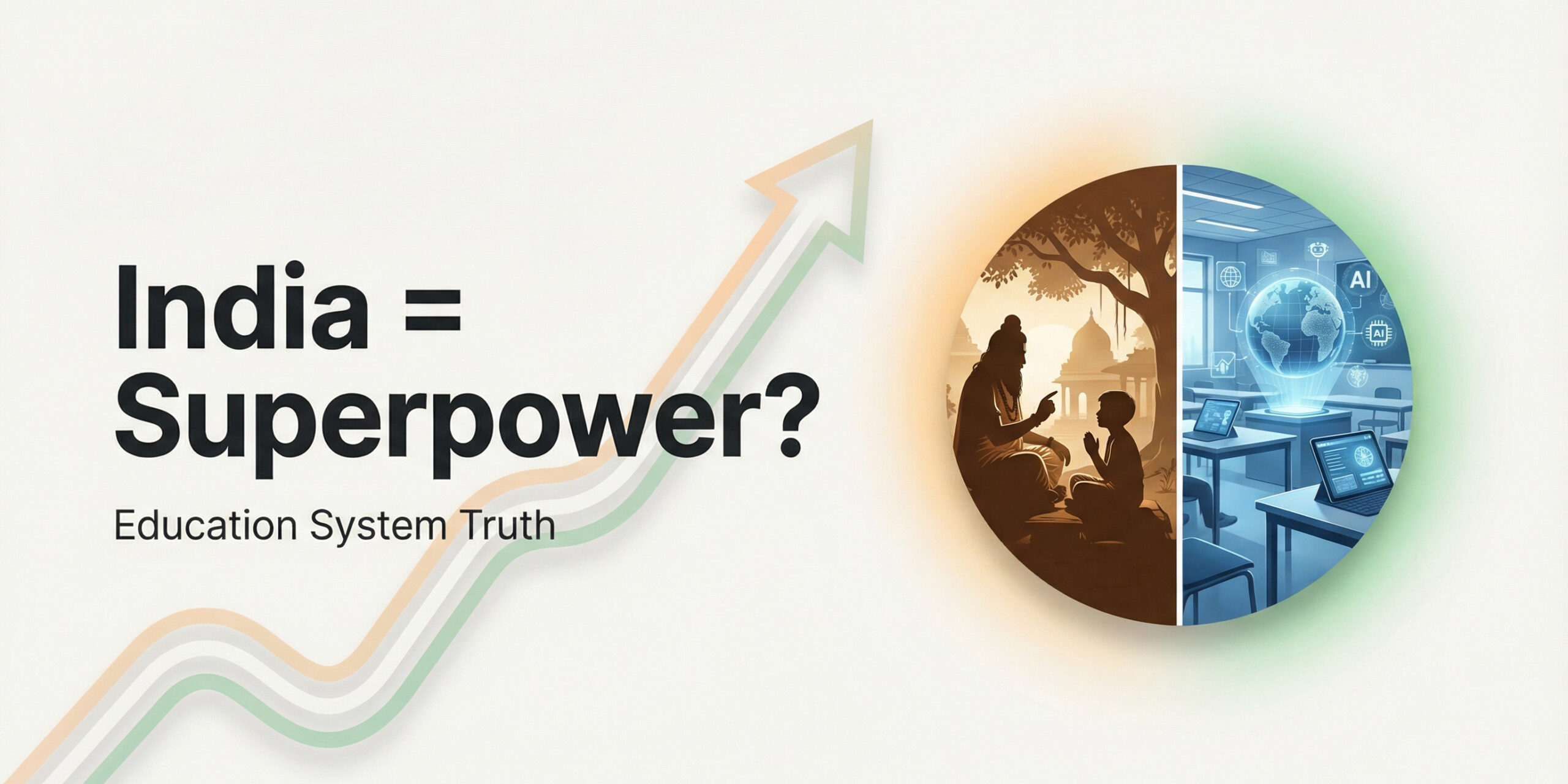
India will be a superpower by 2047—consider this as a bet. I am saying this because if we look 30–40 years back, how many Indians or people of Indian origin were there in leadership positions across the world? Only a few. But today, there is an increasing demand for Indians to fit into leadership roles.
30 years ago, how many Indians were there in the list of the richest people on Earth? But today, we have occupied some of the top spots.
India is rapidly adopting technology, and by 2047, we will be a superpower nation. And in this, our education system plays a very important role.
Hi, I am Raj Malhotra, and in this article, we will understand India’s education system. So let’s start from the beginning.
Ancient Indian Education System – Gurukul
India’s oldest education system is called the Gurukul system. In this system:
- Students were called Shishya
- Teachers were called Guru
In this system, the student used to live in the teacher’s house and gain knowledge there. Along with learning, they also helped in the daily activities of the Guru.
Because of this, an emotional bond used to develop between the Guru and the student.
In the Gurukul system, more focus was given to practical knowledge of religion, warfare, and other aspects. That is why it is also called one of the best education systems in the world.
And why not? If you are getting practical knowledge that can be used in your daily life, then it is obviously beneficial.
Even Gandhiji referred to this education system as a “beautiful tree.”
Modern Indian Education System (British Influence)
Now let’s talk about the modern education system of India, which we follow today.
The foundation of this system was laid by the British in 1830, based on the recommendations of Thomas Babington Macaulay.
This is the system in which the concept of classroom learning was introduced.
In this system:
- More focus was given to subjects like Science and Mathematics
- Subjects like Philosophy, Ethics, Moral Values, and Metaphysics were removed from the education system
The biggest change introduced was that all education would now be converted into English.
Post-Independence Education Reforms
India became independent in 1947, and in 1948, the first education commission was set up under the chairmanship of Dr. Sarvepalli Radhakrishnan.
The purpose of this commission was to understand what direction higher education in India should take. It is known as the University Education Commission.
Similarly, in India:
- Kothari Commission
- Acharya Narendra Dev Committee
- Mudaliar Commission
- National Knowledge Commission
- National Education Policy of 1986
- And the most recent, National Education Policy 2020
Through the recommendations of these committees and policies, many developments have taken place in the education system.
Rise of Online Education
During the COVID period, there was a lot of discussion about online education and online learning.
Many people learned things they had never even imagined. At the same time, many people whose education was incomplete were able to complete their learning.
The National Education Policy 2020 has also focused a lot on online education.
Government Focus on Online Learning
The government, through the National Education Policy, is focusing a lot on online learning.
And online learning has both advantages and disadvantages.
Advantages of Online Learning
- Flexibility: You can complete these courses in your free time without disturbing your daily tasks
- Affordability: Online courses are generally more affordable
- Diverse Options: You can learn anything—whether it is digital marketing or fluent English speaking—very easily online
Disadvantages of Online Learning
- Teacher-to-student feedback is very limited
- Students’ screen time increases
- One-on-one guidance from teachers is not available
Final Thought
From Gurukul to online learning, India has advanced a lot throughout the year.
But one thing that was true earlier and is still true today is that practical learning and practical skills are very important for students.
Now tell me, what do you find more beneficial—classroom learning or online learning, and why? Do share your thoughts.
Stay connected with us !!