
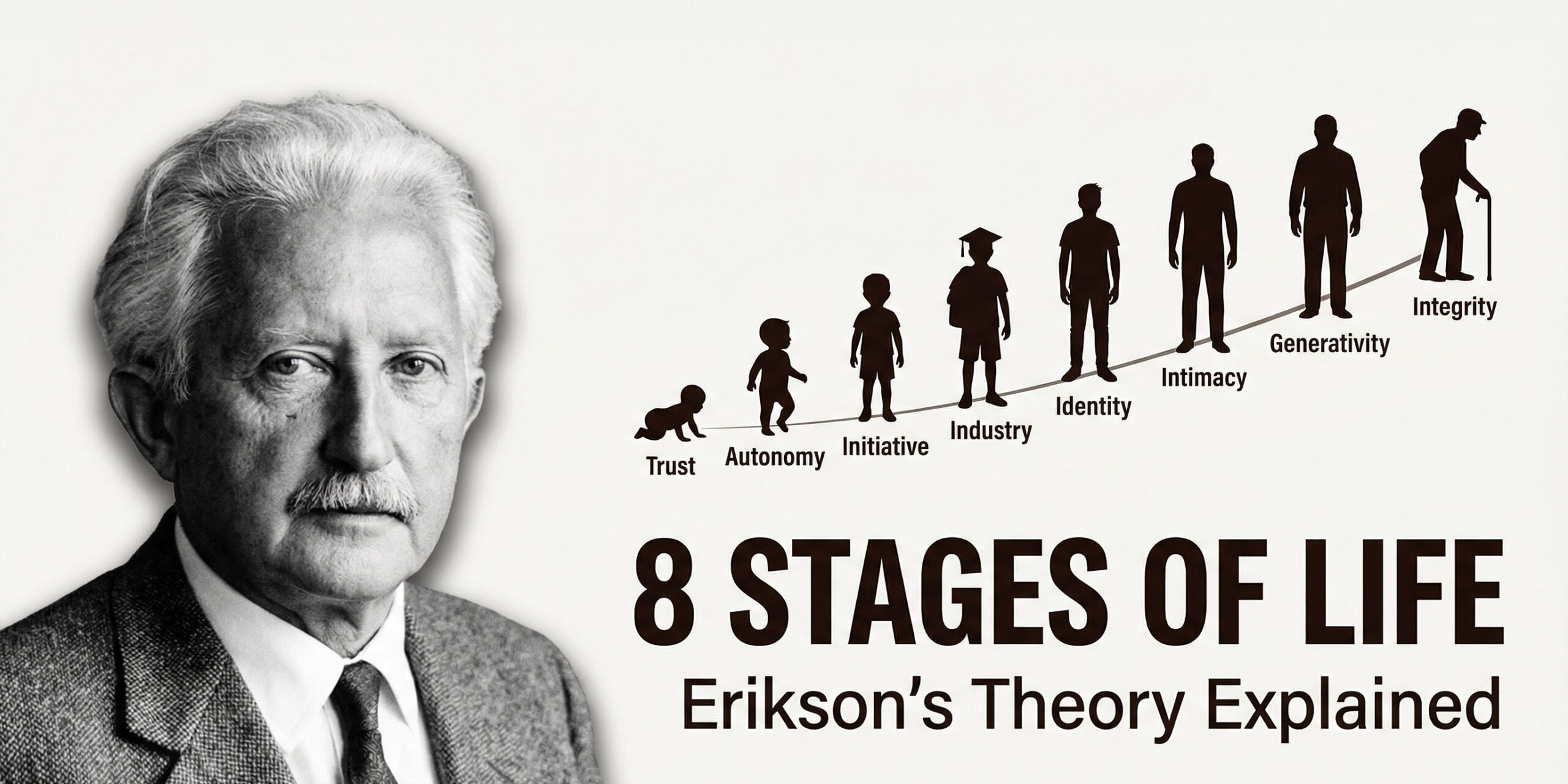
Erik Erikson was a German-American developmental psychologist who is best known for his theory on psychosocial development. He was born on 15 June 1902 in Frankfurt, Germany. Due to discrimination against the Jewish population under Nazi rule in Germany, he had to leave Germany and settled in the USA. He died on 12 May 1994 in Massachusetts, USA.
Erikson published one of the most popular and influential theories on personality development. This theory was centered around psychosocial development. In general, Erikson’s focus was to study how social and cultural factors influence human development.
What is Psychosocial Development?
Now a question should come to your mind that what is psychosocial development. If we break the word psychosocial, what we get is psycho and social. Psycho means something related to your mind and behavior and social means which is related to society and community. So psychosocial means where we study social factors that impact human mind or behavior. And as we already know that Erikson’s major focus was how social and cultural things impact human personality or behavior, right.
Overview of Erikson’s Theory
Erikson said in his psychosocial theory that each human being passes through eight psychosocial developmental stages. These eight stages are, please have a look. Before knowing all these stages in detail, let us take an overview of Erikson’s theory. Erikson believed that personality development happens in a sequence of stages like from stage one to stage two and.
His theory was based on the epigenetic principle. The epigenetic principle says that humans grow step by step in a sequence over a long period of time in a proper sequence. According to Erikson, each stage builds on previous stages and makes a path for future development. Another major point in Erikson’s theory is that in every stage people experience a conflict which becomes an important turning point in their personality development.
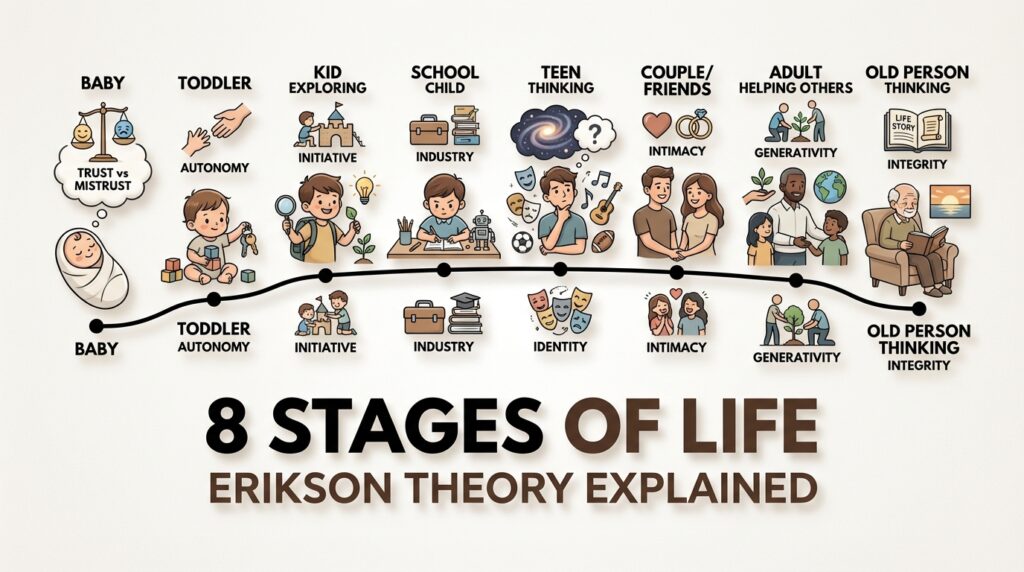
You will see further that in each psychosocial stage of Erikson there is a central conflict which every individual has to go through. If they fail in that conflict then they are not able to develop the essential skills of that stage and they have to struggle throughout life. Erikson also says that each stage is related to a specific virtue or competence. If that stage is handled properly then the person feels a sense of mastery in that competence which we can also call ego strength.
Ego Strength
Ego strength can be understood like this that if a small child loses a race in school and instead of becoming depressed or hopeless says that one loss cannot define my athleticism, I am way more strong and resilient, this is ego strength, believing in one’s own strength.
Stage 1: Trust vs Mistrust
Now let us talk about the first psychosocial stage which is trust versus mistrust. This stage occurs from birth to 18 months. In this stage the key focus is that an infant develops trust in the caregiver or the world. Developing trust is very important to engage with the world. It is the most fundamental of life because the infant is completely dependent on the caregiver whether it is food, safety or warmth.
The central conflict in this stage is that either the infant will develop trust in the caregiver or mistrust will remain. Now whether the infant develops trust or not largely depends on adults and caregivers. Guess what kind of outcomes can come in this stage. If the caregiver provides food and love and remains emotionally available then the child will successfully develop trust and will feel safe and secure in the outside world. But if the caregiver is inconsistent, emotionally unavailable, rude then the child will not develop trust. The child may think that these adults do not even take care of me, why should I trust them.
Now if trust does not develop then it will result in fear and the child will develop a belief that the world is inconsistent. If a child trusts the world around him or her then they will be able to face the world with hope. So in this stage the virtue that develops is hope.
Stage 2: Autonomy vs Shame and Doubt
Now we come to the second stage autonomy versus shame and doubt. This is the stage of early childhood from 18 months to 3 years. In this stage the key focus is that a sense of autonomy and independence develops in the child’s behavior. The child should not remain dependent on the caregiver for everything. Basic actions like walking, eating with their own hands, what to wear, which toy to play with etc.
In this stage the conflict is that on one side the child has desires to do things of their own choice versus on the other side there is parental control. If the caregiver is a little restrictive like do not do this, do not do that etc., then children start doubting their abilities and their choices. Children think that if I played with this toy did I do something wrong. They feel shame and doubt in what they do.
On the other hand if the caregiver is supportive and allows the child to take independent actions then the child develops a sense of autonomy and self-confidence. And in this way when the child explores according to their own will then the virtue that develops is will. Erikson believed that achievement of development stays stage.
Stage 3: Initiative vs Guilt
This stage occurs in preschool years roughly between three to five years. In this stage children become more curious and adventurous and start exploring the world around them more. In this stage the key focus is that a child develops a sense of purpose and capacity to explore the world around them.
The central conflict in this stage is that on one side there are the child’s desires to take initiative actions and understand the world versus on the other side there are societal and parental expectations. For example a 4-year-old child takes interest in arranging plates on the table. Suppose he accidentally drops a plate or parents fear that he will drop and break it, then parents scold and stop him. The child feels guilt and shame.
How will success come in this stage? When a child is able to find the right balance between taking initiative and the consequences of that initiative. Children who are successful in this stage develop curiosity, initiative and the ability to set goals. The virtue that emerges is purpose. They feel confident in leading others in life because they are curious and not afraid of taking initiative. Children who fail in this stage develop a sense of guilt, start doubting themselves and hesitate to take initiative.
Stage 4: Industry vs Inferiority
The fourth psychosocial stage is industry versus inferiority which comes in early school years between age 5 to 11. In this the primary focus is on developing mastery in various skills and tasks and developing a sense of competence. Children in this stage are involved in many activities in school, at home and in their colony whether it is sports or extracurricular activities with classmates and friends.
The primary focus is that in whichever task they are involved they show proficiency and feel capable. Children have to overcome social and academic demands. The central conflict is between industry and inferiority. Industry means that children successfully complete a task and.
When children compare themselves with their friends then they either feel pride or feel inferior. In this stage parents and teachers both play a very important role. Those children who get proper opportunity, feedback and encouragement develop mastery in skills naturally. In this stage the virtue that develops is competence. And those children who receive unnecessary criticism from adults or peers and where there are unrealistic expectations from children, there children feel inferior.
Stage 5: Identity vs Confusion
Erikson’s fifth stage is identity versus confusion. This stage comes in teenage years between 12 to 18 years. In this stage the primary focus is to develop a coherent and clear sense of self and identity. When psychologists talk about identity it means our beliefs, our ideals and aspirations which shape our behavior and personality.
In this stage teenagers explore existence and progress towards developing a stable and consistent identity. The central conflict is between identity and role.
Real-Life Identity Conflict Example
Surya who comes first in 100 meter, 200 meter, 400 meter, javelin throw in school. He gets a lot of praise from teachers, parents and friends. But parallelly Surya has a great interest in book reading. Whenever he gets free time he reads books of authors from different countries. He has a personal blog.
He is discovering identity in the world of books and knowledge. On the other hand he has a role of a sports person. There are societal expectations, parents’ expectations, friends’ expectations that he should prepare for state level, district level, national level and become an Olympic athlete. On one side there is his identity and on the other side there are expectations created by society, so there is a constant conflict.
The successful resolution of this stage leads to the development of a clear and stable identity.
Successful vs Unsuccessful Identity Development
Consider this example, on one side there is Sara who explored many interests, hobbies and beliefs in her teenage. After all this she developed a passion for art. Her identity is stable around art and in real life also she follows it. For Sara the probability of being successful in real life will be very high. The virtue developed in this stage is fidelity which means loyalty towards your own beliefs, aspirations and passions.
On the opposite there is Rohan. He also explored many interests in his adolescence. Ultimately his interest developed in cycling but due to financial obligations now he is applying for a job in a software company. Family and society want to see him as a software developer instead of a cyclist. So Rohan is stuck between his true identity and the societal role.
Stage 6: Intimacy vs Isolation
Erikson’s sixth psychosocial stage is intimacy versus isolation. This stage typically comes in young adulthood from 18 to 40 years. In this stage the primary focus is to develop intimate relationships with others whether it is friendship, romantic partnership or intellectual relationships, meaning building deep meaningful connections.
The central conflict here is that either an adult has meaningful intimate relationships in life with friends and family or he becomes isolated. He may have faced many rejections in life whether in romantic life, professional life or family and friendships. If an adult successfully navigates this stage then he will have good meaningful relationships and will feel love in his social, romantic and personal life.
Here it is important to remember that Erikson used to say that each stage builds on previous stages. Like if in the fifth stage a person forms a stable personal identity and develops a strong sense of self then people will be more attracted to him whether in work, social life or romantic life. And obviously the virtue developed in this stage is love and intimacy.
Stage 7: Generativity vs Stagnation
The seventh stage is generativity versus stagnation which occurs in middle adulthood between 40 to 65 years. In this stage the key focus is on contributing to society or future generations. The question arises that after leaving this world what do I offer. Adults fulfill this need by guiding and nurturing the next generation or by supporting the community.
The central conflict in this stage is that either we stagnate and remain unproductive or we contribute and generate for society. And as it is obvious the virtue developed in this stage is care, care for family and society.
Stage 8: Integrity vs Desperateness
Erikson’s eighth and last stage is integrity versus desperateness. In this stage the primary focus is to look at one’s life lived so far and reflect on it, what kind of life I lived, was my life meaningful.
In brief, people try to decide whether they are happy with the life they have lived so far or they still have deep regrets. So the conflict is that either you are satisfied with life which Erikson calls ego integrity versus you only have regrets that you could not live your life according to your beliefs. There is a feeling of despair or hopelessness.
Those people who successfully navigate this stage accept the last moments of their life. They have very few regrets in life. They finally attain wisdom.
Summary
Now here is the summary of what we have learned so far. So, Erikson in his study covers the entire lifespan and gives a framework of how in each stage you can study psychological changes and identity. But Erikson does not explain what kind of experiences are required in each stage so that an individual can resolve the conflict of that stage and successfully proceed to the next stage.