

Introduction
Today we will talk about Kohlberg’s theory of moral development. Lawrence Kohlberg was a 20th century American psychologist. Lawrence Kohlberg was born on 25th October 1927 in Bronxville, New York.
He worked as a professor in the psychology department at the University of Chicago. He also taught at the Graduate School of Education at Harvard University. Psychologists recognize Kohlberg for his theory of moral development. He drew inspiration for this theory from the stages of cognitive development. Just as a person passes through different cognitive stages, moral development also occurs in stages.
Overview of Moral Development
Moral development happens in three levels and a series of six stages. Kohlberg’s research primarily focused on how children or students take moral decisions when they face a moral dilemma.
Before moving forward, let us understand what moral dilemmas are. These are situations where a person faces two or more moral choices. If you choose one, then you will have to compromise with the other choice. So there is a conflict and a resolvable moral conflict.
The Model Dilemma
Kohlberg developed his theory by creating a model dilemma situation with the help of a story. The researcher presented the story to students aged 16. The researcher then asked many types of questions based on that story.
The story flows something like this: because he belongs to a lower middle-class family, he cannot afford such an expensive medicine. He also tries to take it on credit and even begs, but the chemist does not listen. Finally, he returns home, and after a lot of thinking, that same night he goes to the chemist’s shop and enters the shop and steals the medicine. If you were in his place, would you steal the medicine to save your wife’s life?
Levels of Moral Development
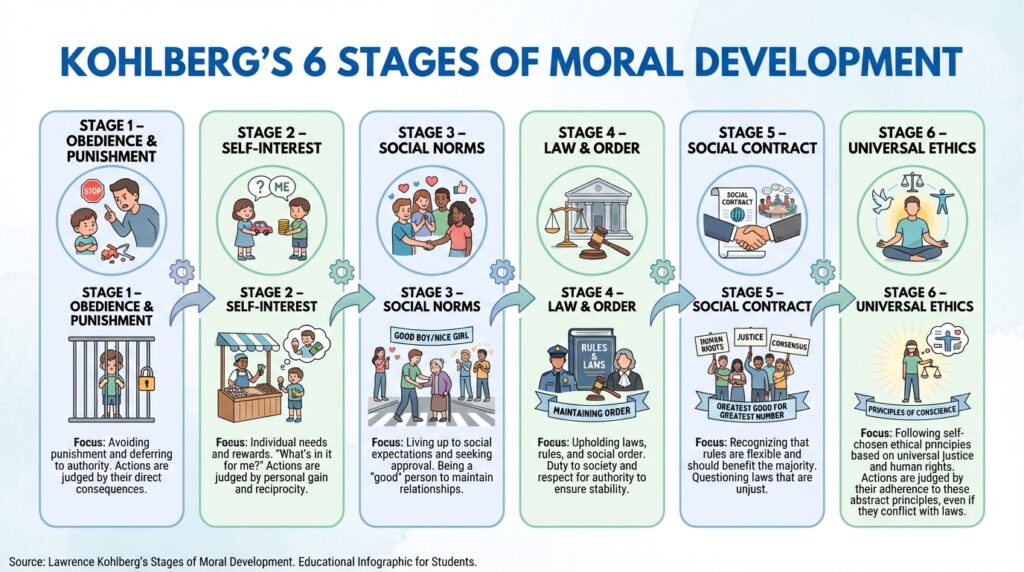
Number 3, post-conventional level. The third level is divided into two stages, from stage 5 to stage 6. At the pre-conventional level, morality is almost negligible. Here, moral reasoning focuses on whether the decision serves one’s self-interest. If it does, the decision is seen as right. This stage is mostly observed in school-going children.
Let us understand each stage one by one.
Stages of Moral Development
Stage 1: Obedience and Punishment
In this stage, moral judgment is based on obedience and fear of punishment. This type of reasoning is found more in children, but adults also show this type of reasoning. According to Kohlberg, at this stage people consider rules as fixed and absolute. Following rules is important because it is an easy way to avoid punishment. For example, a small child raising his hand before asking a question in the classroom because the teacher has said so.
Stage 2: Self-Interest
In this stage, moral judgment is based on self-interest and tit-for-tat exchange. Children mainly follow this type of moral reasoning and take decisions based on their self-interest and benefits. For example, in Kohlberg’s study many children justified stealing by saying that it fulfills the need, like for the treatment of his wife.
Stage 3: Social Norms
People try to follow social norms. For example, in Indian society, people see respect for elders as a sign of a good child, so they develop this “good girl” or “good boy” behavior. If a person reaches the third stage of moral development, they follow what society expects. If social norms suggest that a good husband should even steal to save his wife from death, people may see stealing as justified.
Stage 4: Law and Order
In this stage, moral judgment is based on law and order. Here people start believing that maintaining social order is very important. Rules and laws are not just personal choices but are necessary for the functioning of society. A person thinks that people should follow laws because they benefit everyone. For example, saying that the medicine in the chemist’s shop is the property of the chemist, he has the first right over it, so one should not steal it even if his wife’s life is at risk.
Stage 5: Social Contract
Stage 5: in this stage, moral judgment is based on social contract and individual rights. Here, people understand that society creates laws, and people can change them if they do not benefit society. A person believes that rules should protect human rights and welfare.
If a law is unfair, then it should be modified. For example, one may say that although stealing is generally wrong, but saving a life is more important, so in this situation stealing the medicine can be justified because it protects a human life.
Higher Stages and Moral Reasoning
Some stages are not reached by everyone. For example, a person may believe that the medicine in the chemist’s shop belongs to the chemist. They think the chemist has the first right over it.
So, they believe one should not steal it, even if his wife’s life is at risk.
Stage 6: Universal Ethical Principles
In this stage, moral judgment is based on universal ethical principles. In this stage, people create their own moral principles whether they fit with society’s norms or not, like Mahatma Gandhi following the path of non-violence even against British principles.
Criticism of Kohlberg’s Theory
Kohlberg’s theory has also received strong criticism. One of the most prominent criticisms is that his theory is gender biased. He conducted the entire study on males, so the resulting theory of morality reflects only the male perspective. It completely ignores the female perspective. Another criticism by his famous student Carol Gilligan was that Kohlberg’s theory gives more emphasis on concepts like justice and does not adequately address morality based on care and compassion. On average, women’s moral judgment score is higher than men.
Another criticism of Kohlberg is that there is age bias in this theory. The students who participated in his study were between 10 to 16 years old. Possibly they did not have any experience of marriage, so for them understanding Heinz and his wife’s cancer situation and contextualizing their moral dilemmas becomes a little difficult.
Moral Judgment vs Moral Behavior
If your younger brother is caught stealing, what will you do? You might confidently say that, according to the law, you should report him to the police. This is your moral judgment. But it is not necessary that in real life if this happens, you will report your younger brother to the police. You may scold him or counsel him and try to settle the matter there itself. This is your moral behavior, which is exactly opposite to moral judgment.