
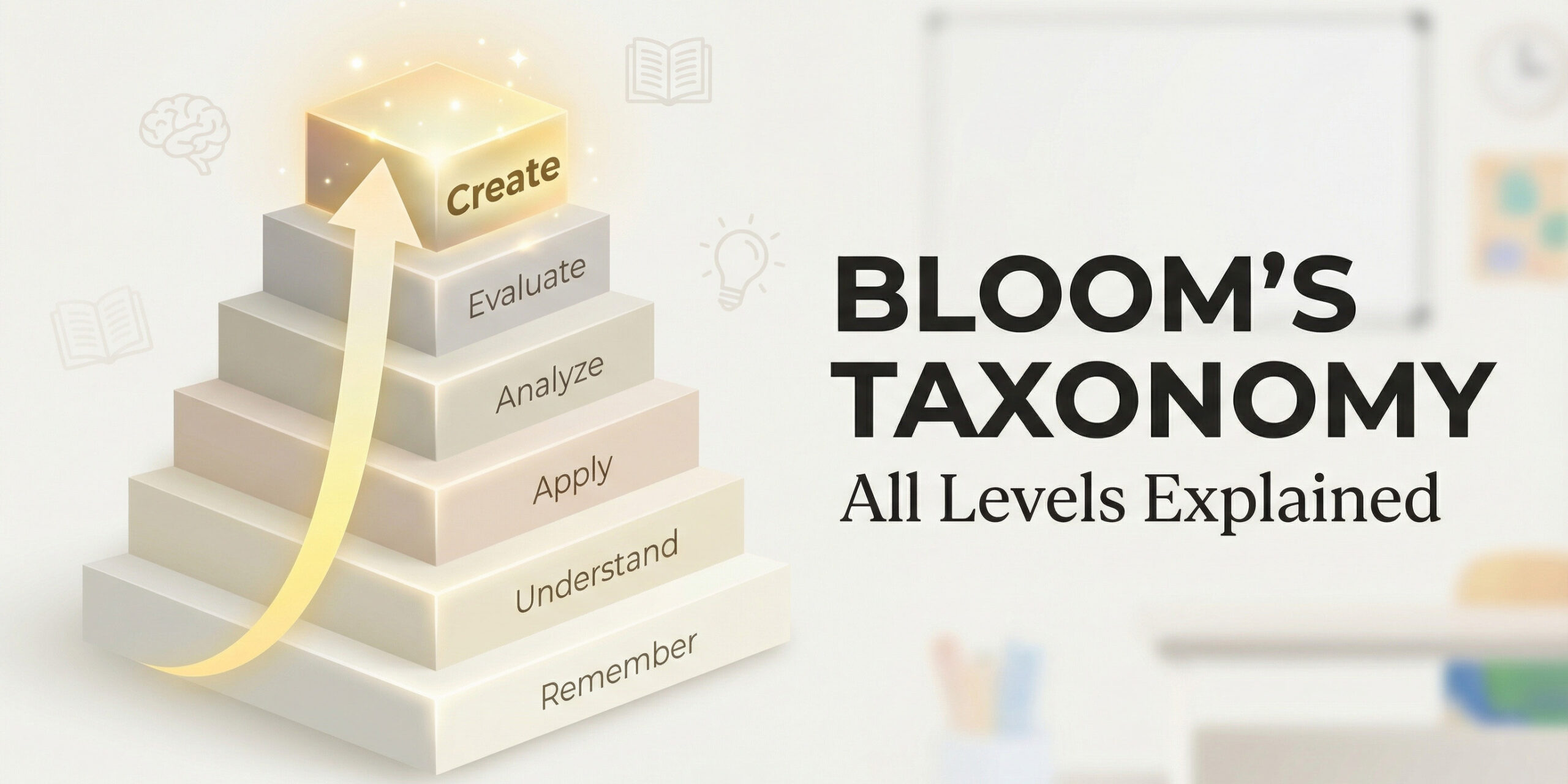
Bloom’s Taxonomy is a very important lecture. This is so common that if you have been preparing for CTET for some time, then you must have heard this name at least once.
Let us move forward, and if there is even a little confusion, then the attempt is to clear that confusion completely from A to Z by explaining even the toughest concepts in the simplest language.
Meaning of Taxonomy and Bloom’s Contribution
Taxonomy means classification. Bloom can be called a researcher who gave this classification.
Classification of what was given? – Classification of the domains of learning.
In how many dimensions learning can happen, in how many dimensions a human being can learn—this was discussed by Bloom. The full name was Benjamin Bloom.
Origin of Bloom’s Taxonomy (1956)
Bloom’s Taxonomy, that is Bloom’s classification, was given in the year 1956. It has been a very long time since then. Benjamin Bloom, along with his colleagues, published a framework for categorizing educational goals which comprised the learning domains.
This means that Bloom and his colleagues conducted research and published a paper.
In that, they explained that whatever education is given to students, the effect or learning of that education can happen in different dimensions or should happen in different dimensions.
They said that within a human being or a student, there are three domains of learning:
- Cognitive domain
- Affective domain
- Psychomotor domain
Cognitive means learning based on intellect.
Affective means learning based on emotions, behavior, and attitude.
Psychomotor means learning based on the body, through certain skills.
Learning is possible in all these three dimensions. The main objective of this taxonomy was to focus more on the cognitive domain. It was believed that if the learner’s cognitive learning is very strong, then the educational objective is achieved.
That is why whenever Bloom’s Taxonomy is discussed, generally the steps of the cognitive domain are discussed more, and the others are not discussed as much.
In all these three domains, what are the stages of learning and how learning happens—this was explained by Bloom in 1956.
Three Domains of Learning
There are three domains:
- Cognitive domain (based on intellect)
- Psychomotor domain (based on body)
- Affective domain (based on mind)
First, let us see the cognitive domain.
Cognitive Domain (Step-by-Step Growth)
In the cognitive domain, learning progresses from basic to advanced.
1. Knowledge
The first step is knowledge. This can be compared with the memory level. Knowledge means the first level of intellect where we receive information and store it in the mind.
At the memory level, we use information like this: We memorized something like a hard disk, and when needed, we write it in the exam.
This is the lowest level of learning in the cognitive domain.
2. Comprehension
After that comes comprehension. This is the understanding level. Here, you have not only memorized something, but you also understand it.
You can explain it in your own words. This is the identity of the understanding level.
3. Application
After comprehension comes application.
Application means: You understand the knowledge, which is good. Now you move one step ahead and apply that knowledge in real life.
For example: If in an engineering class you are told how a motor functions, that is understanding.
But if in real life you can open and build motors around you, then that is application.
4. Analysis
After application comes analysis.
Analysis means the ability to break something into parts and understand it. Generally, we see things as a whole. But a person who reaches the level of analysis can see it in parts.
For example: When we eat something, we say:
- It is tasty
- It is okay
- It is not good
But a person who understands taste deeply can explain:
- What taste came first
- What came in the middle
- What came as aftertaste
That means they are breaking it into parts. This is called analysis.
Similarly, when preparing for exams, instead of seeing it as a whole, you divide it into small parts and study. That is also analysis.
5. Synthesis
After analysis comes synthesis. Synthesis is the opposite of analysis.
In analysis, we break things apart.
In synthesis, we combine things.
For example: A person takes different waste materials and combines them to create something new, like a drum. Or creates inventions from scrap. This is synthesis.
6. Evaluation
The next step is evaluation. Evaluation means understanding what is right and what is wrong.
When this level is reached, it is considered the highest level of cognitive development (according to 1956).
Psychomotor Domain (Learning Through Body)
The second domain is the psychomotor domain.This is about how we learn through physical actions.
Steps:
- Imitation: Learning starts by copying
Example: learning driving or dance by copying - Manipulation: After copying, we start making small changes.
- Precision: We become accurate in the task
- Articulation: We perform the task better and more efficiently
- Naturalization: The task becomes natural
Example: driving or cooking without thinking
Affective Domain (Learning Through Mind)
This domain is about:
- Values
- Attitude
- Behavior
- Personality
Steps:
- Receiving: Taking information through senses
- Responding: Giving a response to what is observed
- Valuing: Giving value (positive or negative)
- Organization: Categorizing values internally
- Characterization: Values become part of character
For example:
If someone is preparing for an exam and watches motivational content, they may value it highly and organize it mentally, which eventually reflects in their personality and behavior.
Learning in the affective domain starts with receiving and ends with character formation.
Revised Bloom’s Taxonomy (2001)
In 2001, Bloom’s Taxonomy was revised. Changes were mainly made in the cognitive domain.
Earlier steps were:
- Knowledge
- Comprehension
- Application
- Analysis
- Synthesis
- Evaluation
Revised steps:
- Remember (instead of Knowledge)
- Understand (instead of Comprehension)
- Apply (same as Application)
- Analyze (same as Analysis)
The major change was in the last two steps:
- Evaluation was moved before
- Synthesis was renamed to Create and placed at the top
Final Steps (2001):
- Remember
- Understand
- Apply
- Analyze
- Evaluate
- Create
The idea was:
Evaluation can be done by many people, but creating something new is the highest level. So creativity was placed at the top.
Final Understanding
The main change in Bloom’s Taxonomy was:
- Synthesis → Create
- Evaluation moved below Create
Stay connected with us !!
Незалежний цифровий простір, присвячена новітнім культурним явищам, мистецтву, звукам, стилю та незалежним медіа. Видання зосереджується на сюжетах, які залишаються поза основною течією: розлогі інтерв’ю з діячами підпільних рухів, огляди на нестандартні релізи, аналізи художніх практик та есеї про трансформацію особистісних наративів. Особлива фокус приділяється вітчизняним мистецьким процесам, самодіяльним артистам, стріт-стайлу та напрямкам, що визначають нову естетику сьогодення. Пізнавати цей світ ви можете на [url=https://necatli.space/]necatli.space[/url], де матеріали об’єднують ґрунтовну аналіз з художніми образами, даючи глядачеві не голі факти, а альтернативну оптику сприйняття реальності.